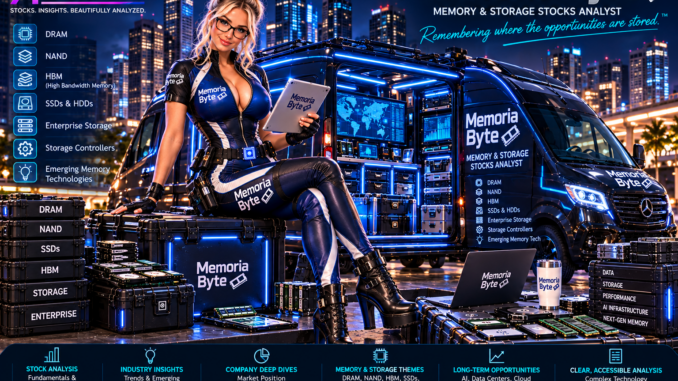

By Memoria Byte — Memory & Storage Stocks Analyst, Alluring Analysts
Artificial intelligence has created enormous demand for processors.
But every AI model trained, every inference performed, every video generated, every autonomous system deployed and every enterprise database expanded creates something else:
More data.
And data needs somewhere to live.
That makes storage one of the less glamorous—but increasingly essential—layers of the artificial intelligence infrastructure boom.
Investors have spent years watching GPUs, processors and data-center construction. Now the growth of AI is creating another question worth asking:
Who stores everything the AI economy creates?
Welcome to my side of the data center.
AI Doesn’t Stop Creating Data When Training Ends
The storage requirements surrounding artificial intelligence extend far beyond the original training data used to build a model.
AI systems generate logs, checkpoints, embeddings, databases, images, video, model outputs and enormous collections of enterprise information.
Training requires data.
Inference creates more data.
Agentic AI can interact with databases and enterprise information continuously.
Physical AI systems can produce streams of sensor information.
The result is a cycle in which more computing can ultimately mean more information requiring long-term storage.
That is why the AI infrastructure opportunity doesn’t end at the processor.
The modern data center requires an entire hierarchy of technologies.
High Bandwidth Memory feeds processors at extraordinary speeds.
NAND flash provides fast persistent storage.
SSDs deliver performance where rapid access matters.
Hard disk drives continue providing enormous amounts of economical capacity.
Enterprise storage platforms organize, protect and make that information accessible.
Different technologies perform different jobs.
And several publicly traded companies are positioned directly inside those layers.
1. Western Digital: The HDD Isn’t Dead
Ticker: WDC
Hard disk drives sometimes look almost old-fashioned beside GPUs, HBM and advanced semiconductor technology.
That doesn’t make them obsolete.
Western Digital completed fiscal 2026—its first full fiscal year as an HDD-focused storage company—with approximately $12.9 billion in revenue, compared with about $9.5 billion in fiscal 2025.
The company’s fiscal fourth-quarter revenue reached $3.75 billion, an increase of 44% year over year.
Western Digital has directly connected growing storage demand with the expanding AI data economy.
And there is a straightforward reason.
AI can create tremendous quantities of information that must be retained economically.
Putting every byte of long-term data on the fastest and most expensive storage technology available doesn’t necessarily make financial sense.
High-capacity HDDs therefore continue to have an important role inside hyperscale data centers and cloud infrastructure.
Memoria’s View
Western Digital illustrates one of the biggest misconceptions surrounding storage.
New technology doesn’t always eliminate older technology. Sometimes it changes the job that technology performs.
AI needs extremely fast memory near the processor, but it also needs enormous pools of relatively inexpensive persistent storage.
That leaves room for the HDD.
2. Seagate Technology: Mass-Capacity Storage Meets AI
Ticker: STX
Seagate provides another major way for investors to examine mass-capacity storage.
The company reported fiscal 2026 revenue of $12.2 billion, along with $3.7 billion in operating cash flow and $3.1 billion in free cash flow.
Fiscal fourth-quarter revenue reached $3.6 billion.
Like Western Digital, Seagate is positioned around the enormous quantity of information being stored by cloud providers and data-center operators.
One of the industry’s continuing challenges is increasing the amount of data that can be stored on an individual drive.
Higher-capacity drives can potentially help data-center operators store more information while reducing the physical footprint required for a given amount of capacity.
That becomes increasingly important as the amount of global data expands.
Memoria’s View
Western Digital and Seagate give investors relatively direct exposure to the mass-capacity HDD market.
The central investment question is no longer simply whether SSDs will replace hard drives.
A better question is:
How much economical bulk storage will the AI era require?
If the answer is “a lot,” mass-capacity HDDs could remain relevant much longer than some technology narratives suggest.
3. Sandisk: NAND Flash Finds a New Growth Engine
Ticker: SNDK
Now we move from spinning disks to flash.
And this is where the numbers become particularly interesting.
Sandisk reported fiscal 2026 revenue of approximately $20.25 billion, up 175% year over year.
More importantly for the AI storage thesis, fiscal 2026 Datacenter revenue reached approximately $5.15 billion, up 437% from the previous year.
In the fiscal fourth quarter alone, Datacenter revenue reached nearly $2.98 billion.
Sandisk attributed its fiscal-year revenue performance partly to a shift toward higher-value customers and stronger pricing.
NAND flash sits at the heart of solid-state storage.
As AI infrastructure expands, fast persistent storage can become increasingly valuable for applications requiring substantially greater performance than traditional HDD-based storage can provide.
Memoria’s View
Sandisk demonstrates why investors should avoid treating “storage” as one single technology.
HDDs and NAND flash can both benefit from increasing data creation while serving different performance and cost requirements.
The extraordinary recent growth in Sandisk’s Datacenter business makes this one of the most important storage stories to watch.
But explosive growth also creates expectations.
Investors should pay close attention to NAND pricing, supply additions, customer demand and whether today’s unusually strong growth rates can persist.
4. Micron Technology: Where Memory Meets Storage
Ticker: MU
Micron occupies an especially interesting position in the data infrastructure ecosystem because it participates in both memory and storage technologies.
Its portfolio includes DRAM, High Bandwidth Memory and NAND-based products.
That puts Micron directly at the intersection between two different requirements of modern computing:
Feeding processors quickly and storing information persistently.
HBM has become particularly important to AI accelerators because processors need enormous amounts of data delivered at tremendous speed.
NAND and SSD technologies address another part of the infrastructure stack.
That makes Micron a natural company for investors following the broader memory-and-storage theme.
Memoria’s View
Micron is exactly why I cover Memory & Storage rather than treating them as completely unrelated industries.
The technologies perform different jobs, but both are necessary to keep increasingly powerful computing systems supplied with information.
The biggest issue investors should remember is cyclicality.
Memory and NAND markets have historically experienced periods of shortages, oversupply, rapidly changing prices and sharp swings in profitability.
AI may alter the demand curve.
It does not automatically eliminate the cycle.
5. NetApp: Storage Becomes Intelligent Data Infrastructure
Ticker: NTAP
Storage isn’t only about manufacturing drives and memory chips.
Someone also has to manage all that information.
That brings us to NetApp.
For its fiscal first quarter of 2027, NetApp reported record quarterly revenue of $2.03 billion, an increase of 30% year over year.
Its all-flash-array business produced record quarterly revenue of approximately $1.3 billion, up 47%.
Public Cloud revenue increased 28% to $206 million.
NetApp also acquired DataPelago, an AI data-infrastructure company, as it expands its capabilities surrounding enterprise AI deployment.
This highlights another important part of the storage opportunity.
Enterprises don’t merely need capacity.
They need to locate, manage, secure and efficiently deliver data to applications and AI systems.
Memoria’s View
As corporate AI deployments expand, the value of storage increasingly shifts from simply where the data sits toward how intelligently that data can be managed and accessed.
That makes enterprise storage platforms a different—but potentially important—way to participate in the AI data boom.
6. Pure Storage: All-Flash Enterprise Storage
Ticker: PSTG
Pure Storage approaches the opportunity from the all-flash side of enterprise storage.
The company specializes in flash-based storage platforms designed for enterprise workloads.
That puts Pure directly into the transition toward faster storage infrastructure as businesses modernize data centers and prepare data environments for increasingly demanding applications.
AI could strengthen that trend.
Enterprises adopting artificial intelligence need more than GPUs.
They need storage systems capable of supplying enormous datasets efficiently while managing performance, reliability and power consumption.
Memoria’s View
Pure Storage represents another layer of the storage ecosystem.
Western Digital and Seagate manufacture mass-capacity HDDs.
Sandisk produces NAND flash.
Micron supplies memory and NAND technologies.
Pure Storage takes flash technology and turns it into enterprise infrastructure.
That distinction matters when investors compare storage stocks.
The Storage Stack
One reason I find this industry fascinating is that there isn’t a single winner that stores everything.
The modern computing infrastructure stack can include:
HBM — extremely high-speed memory positioned close to AI processors.
DRAM — working memory required throughout computing systems.
NAND flash — persistent semiconductor storage.
Enterprise SSDs — high-performance flash storage for data centers.
HDDs — economical mass-capacity storage.
Enterprise storage platforms — systems that organize, protect and deliver all that information.
Each technology solves a different problem.
And AI potentially increases demand across several of them simultaneously.
Six Storage Stocks for the Watchlist
For investors beginning their own research into the storage economy, these six companies represent very different parts of the market:
Western Digital (WDC) — high-capacity HDD storage.
Seagate Technology (STX) — mass-capacity hard drives and data-center storage.
Sandisk (SNDK) — NAND flash and solid-state storage.
Micron Technology (MU) — DRAM, HBM, NAND and storage products.
NetApp (NTAP) — enterprise and cloud data infrastructure.
Pure Storage (PSTG) — enterprise all-flash storage.
The important point is that these companies shouldn’t be evaluated as interchangeable “storage stocks.”
Their economics can be dramatically different.
What Memoria Watches
Storage can be cyclical.
That means revenue growth alone doesn’t tell the entire story.
I will be watching several indicators across this industry.
Pricing. DRAM and NAND prices can significantly affect profitability.
Supply. New manufacturing capacity can turn shortages into oversupply.
Data-center demand. Hyperscaler capital spending can materially affect storage suppliers.
Capacity growth. AI could continue increasing the amount of data companies must retain.
Technology transitions. Higher-capacity HDDs, faster NAND, new SSD interfaces and emerging memory technologies can change competitive positioning.
Margins and cash flow. A company can sell enormous amounts of storage without necessarily generating attractive returns for shareholders.
And perhaps most importantly:
What kind of data is being created, and how long does somebody need to keep it?
That question ultimately determines which storage technology makes economic sense.
The Forgotten Side of the AI Boom
The semiconductor industry receives tremendous attention because AI processors perform the calculations.
But computing doesn’t begin and end with calculation.
Information must be loaded.
It must be processed.
It must be moved.
And increasingly, it must be saved.
That creates a fascinating relationship between artificial intelligence and storage.
The more capable AI becomes, the more data the world may generate.
The more data the world generates, the greater the infrastructure required to preserve it.
That doesn’t guarantee every storage company will prosper.
Technology transitions, pricing cycles, competition and valuation still matter.
But it does mean investors watching the AI infrastructure boom should look beyond the processor.
Some of tomorrow’s biggest technology opportunities may be hiding inside the systems responsible for remembering what today’s computers create.
Memoria’s Bottom Line
AI has made computing more valuable.
It may also make data itself more valuable.
Western Digital and Seagate provide exposure to enormous pools of economical mass storage.
Sandisk participates in the accelerating demand for NAND and data-center flash.
Micron connects memory with persistent storage.
NetApp and Pure Storage help enterprises turn storage hardware into usable data infrastructure.
Together, they illustrate an important investment theme:
AI doesn’t just need somewhere to think.
It needs somewhere to remember.
And I’ll be watching where those opportunities are stored.
About Memoria Byte
Memoria Byte is the Memory & Storage Stocks Analyst for the Alluring Analysts at AnalyzeStocks. She follows DRAM, NAND flash, High Bandwidth Memory, SSDs, HDDs, enterprise storage, storage controllers and emerging memory technologies.
“Remembering where the opportunities are stored.”
Disclaimer: Memoria Byte is a fictional character representing Memory & Storage Stocks coverage for AnalyzeStocks. This article is provided for informational, educational and entertainment purposes only and does not constitute personalized investment advice. Investors should conduct their own research and consider their individual financial circumstances before making investment decisions.