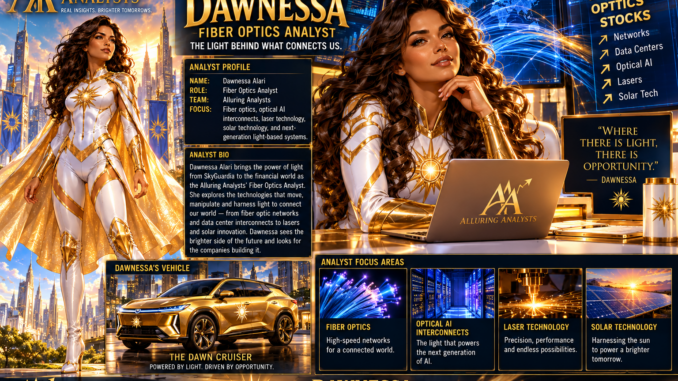

By Dawnessa Alari — Fiber Optics Analyst, Alluring Analysts
Artificial intelligence has created extraordinary demand for GPUs and other advanced processors.
But there is a problem.
Building faster processors doesn’t accomplish nearly as much if those processors cannot communicate with one another quickly enough.
As AI data centers become larger and more powerful, moving enormous quantities of information between GPUs, servers, switches and entire data centers is becoming one of the industry’s most important challenges.
That is bringing an older technology into one of the newest investment stories in the market:
Fiber optics.
The artificial intelligence boom is increasingly becoming an optical networking boom as well.
And for investors, that creates an entirely different group of AI infrastructure stocks to investigate.
AI Is Creating a Bandwidth Problem
An AI data center isn’t simply a room containing thousands of powerful processors.
Those processors must operate together.
Training and running increasingly sophisticated artificial intelligence models requires tremendous amounts of data to move rapidly throughout computing clusters. As the number and speed of processors increase, the network connecting them becomes increasingly important.
Eventually, simply adding more computing power can produce diminishing benefits if information cannot move through the system fast enough.
Traditional copper connections remain useful, particularly over short distances, but the industry’s requirements for bandwidth, distance and energy efficiency are pushing optical technologies deeper into AI infrastructure.
Light can move tremendous amounts of information.
And suddenly, that makes fiber one of the technologies helping determine how large AI systems can become.
Corning: Fiber Moves Into the AI Factory
Ticker: GLW
Corning is one of the most recognizable names in optical fiber, and its recent results demonstrate just how quickly artificial intelligence is changing the optical communications business.
In the second quarter of 2026, Corning reported that Optical Communications sales increased 32% year over year to $2.07 billion.
Enterprise Networks sales increased 65%, with the company saying sales of products associated with generative AI grew significantly faster.
That is a powerful signal.
AI demand is no longer merely appearing in semiconductor earnings reports. It is becoming visible in the companies supplying the physical connections between computing systems.
Corning has been developing higher-density connectivity products designed specifically for increasingly demanding AI networks, including multicore fiber, high-density cables and connectors, and technology supporting co-packaged optics.
The scale of the opportunity became even clearer in May.
NVIDIA and Corning announced a multiyear commercial and technology partnership under which Corning plans to increase its U.S. optical connectivity manufacturing capacity tenfold and expand U.S. fiber-production capacity by more than 50%.
Three new manufacturing facilities are planned as part of the expansion.
That isn’t a small adjustment to an existing production line.
It is evidence that companies building next-generation AI infrastructure expect enormous quantities of optical connectivity to be required.
Dawnessa’s View
Corning gives investors exposure to one of the most fundamental pieces of the optical ecosystem: the fiber and connectivity infrastructure itself.
The important question isn’t whether AI needs fiber.
It increasingly does.
The investment question is how much of that demand translates into sustained revenue and profit growth after the current infrastructure boom matures.
Lumentum: AI Demand Is Already Showing Up in the Numbers
Ticker: LITE
Lumentum provides another striking example of the optical AI boom.
The company reported fiscal 2026 revenue of approximately $3.01 billion, an increase of 83.2% from fiscal 2025.
Its fiscal fourth-quarter revenue reached approximately $1.01 billion, more than double the comparable quarter a year earlier.
Management has specifically pointed toward increasing AI computing speeds and bandwidth requirements as a reason data-center architects are moving toward optical links.
Lumentum is also advancing technologies including 1.6-terabit optical modules and optical circuit switching.
Those numbers illustrate something important about the current fiber-optics investment story.
This isn’t solely a future prediction.
AI-related optical demand is already affecting company financial results.
Dawnessa’s View
Lumentum offers more concentrated exposure to optical communications than a highly diversified company such as Corning.
That concentration can create substantial upside when optical demand accelerates—but it can also produce considerably more volatility if spending slows.
Fiber-optics investors should remember that the brightest growth markets can still produce very volatile stocks.
Coherent: The Components Behind High-Speed Connections
Ticker: COHR
Coherent participates across optical communications, lasers and advanced materials, placing the company directly inside several technologies required for high-speed data transmission.
Optical transceivers are particularly important.
A fiber cable alone cannot connect an AI cluster.
Electronic information must be converted into optical signals, transmitted using light and converted again at the other end.
That requires lasers, optical components, transceivers and increasingly sophisticated photonic systems.
As data-center networking moves toward higher speeds—including 800G and 1.6T connections—the technology inside those optical links becomes more demanding.
That creates opportunities for component suppliers such as Coherent.
Dawnessa’s View
The optical AI opportunity isn’t merely about laying more fiber.
The increasing sophistication of the equipment attached to each end of that fiber may prove just as important.
That makes optical-component manufacturers an essential part of the story.
Broadcom: Bringing Optics Closer to the Chip
Ticker: AVGO
One of the most interesting developments in AI networking is co-packaged optics, commonly called CPO.
Traditional networking equipment keeps optical components relatively separate from the switching silicon.
But as network speeds increase, moving electrical signals even relatively short distances can consume increasing amounts of power and create additional complexity.
Co-packaged optics attempts to move optical connectivity much closer to the networking chip itself.
Broadcom demonstrated a 102.4-terabit Ethernet switch with co-packaged optics as part of its AI infrastructure portfolio at OFC 2026.
The company is also developing high-speed optical DSPs and other connectivity technologies intended for increasingly enormous AI clusters.
This represents an important evolution.
Fiber isn’t merely reaching the data center.
Optics are moving progressively closer to the computing silicon itself.
Dawnessa’s View
Broadcom illustrates where semiconductor technology and optical networking begin to merge.
That boundary could become one of the most important areas to watch as AI clusters grow.
Marvell: Betting on the Optical Interconnect
Ticker: MRVL
Marvell provides another bridge between semiconductors and optical connectivity.
The company participates in networking silicon, custom AI chips and advanced interconnect technologies.
And its long-term expectations demonstrate how large management believes the opportunity could become.
At its October 2026 investor day, Marvell outlined ambitious long-term revenue targets, with its interconnect business—including advanced optical networking—expected to become a major contributor.
That matters because the AI infrastructure debate is gradually shifting.
The market spent several years asking:
Who makes the fastest AI accelerator?
Increasingly, another question matters:
How do we connect all these accelerators together?
The answer may create a significant second layer of AI infrastructure winners.
Dawnessa’s View
Marvell sits at an interesting intersection of custom computing and connectivity.
That also means investors should carefully separate the company’s various growth drivers rather than assuming every dollar of future growth comes directly from fiber optics.
Ciena: Moving Data Beyond a Single AI Cluster
Ticker: CIEN
Not every optical connection exists inside one building.
AI infrastructure increasingly involves multiple data centers, cloud regions and enormous networks transporting data over much greater distances.
Ciena specializes in optical networking equipment designed to move enormous quantities of information across communications networks.
As AI workloads expand geographically, the distinction between networking inside a data center and networking between data centers becomes increasingly important.
The AI economy needs both.
Dawnessa’s View
Ciena expands the fiber-optics investment thesis beyond individual AI racks and clusters.
Artificial intelligence may ultimately require a much larger optical backbone connecting computing infrastructure across cities, regions and continents.
Applied Optoelectronics: Smaller Company, Bigger Risk
Ticker: AAOI
Applied Optoelectronics supplies fiber-optic networking products used in internet data centers, telecommunications and broadband applications.
Compared with giants such as Broadcom or Corning, Applied Optoelectronics represents a smaller and potentially more volatile way to participate in optical infrastructure growth.
Smaller companies can sometimes grow much faster when an industry expands.
They can also be more vulnerable to customer concentration, manufacturing challenges, changing technology and fluctuations in demand.
Dawnessa’s View
AAOI demonstrates why investors shouldn’t treat every fiber-optics stock identically.
The underlying technology trend may be attractive while the individual companies participating in it carry dramatically different levels of financial and operational risk.
The Next Step: 1.6T and Beyond
The speed of optical networking continues to increase.
The industry has moved through generations of 100G, 400G and 800G connections, while 1.6-terabit optical technology is now moving into the next stage of deployment.
And it won’t end there.
Faster AI accelerators create demand for faster networks.
Faster networks enable larger AI clusters.
Larger clusters create demand for still more bandwidth.
That creates a reinforcing cycle.
But speed isn’t the only challenge.
Power consumption may become just as important.
AI data centers already require enormous amounts of electricity. If the energy required merely to move information between processors grows too quickly, networking itself becomes an obstacle to scaling AI.
Optical technologies potentially provide part of the solution.
Why Fiber Could Become an AI Bottleneck
Investors frequently focus on the scarcity of advanced GPUs.
But an AI system is constrained by more than processors.
It needs:
Compute.
Memory.
Storage.
Networking.
Power.
Cooling.
If any one of those becomes insufficient, the entire system can be constrained.
Fiber optics and optical networking increasingly sit inside that chain.
A $50,000 accelerator waiting for data isn’t delivering its full economic value.
That is why bandwidth matters.
And it is why optical networking may become one of the most important supporting industries of the artificial intelligence boom.
Seven Fiber and Optical Stocks for the Watchlist
Investors exploring this theme may want to research companies across several parts of the optical value chain:
Corning (GLW) — optical fiber and connectivity infrastructure.
Lumentum (LITE) — optical components, modules and lasers.
Coherent (COHR) — transceivers, optical components and photonics.
Broadcom (AVGO) — networking silicon, optical DSPs and co-packaged optics.
Marvell Technology (MRVL) — advanced interconnects, optical DSPs and data-center networking.
Ciena (CIEN) — optical networking systems.
Applied Optoelectronics (AAOI) — optical networking products serving data-center and communications markets.
These companies are not interchangeable.
Some are diversified technology giants.
Others provide relatively concentrated exposure to optics.
Some have already experienced tremendous stock appreciation as investors recognize the AI connectivity opportunity.
That means valuation matters.
The Risks Investors Shouldn’t Ignore
A powerful technology trend does not automatically produce a good investment at every price.
Optical networking companies face several risks.
AI infrastructure spending could slow.
Large customers could reduce capital expenditures.
New technologies could alter which components are required.
Competition could pressure margins.
Manufacturing expansions could create excess capacity if demand expectations prove too optimistic.
And stocks associated with artificial intelligence can become extremely expensive when enthusiasm outruns fundamentals.
The fiber-optics thesis should therefore be evaluated company by company.
Dawnessa’s Bottom Line
The artificial intelligence revolution isn’t powered by processors alone.
AI needs light.
As computing clusters become larger, processors become faster and data centers consume ever greater quantities of information, the networks connecting those systems must evolve with them.
That puts fiber optics, lasers, transceivers, photonics and optical networking into an increasingly important position inside the AI infrastructure economy.
Corning’s rapidly growing Optical Communications business provides evidence that the opportunity is already materializing.
Lumentum’s extraordinary fiscal 2026 growth provides another.
And technologies such as 1.6T optical modules and co-packaged optics suggest that the evolution is far from finished.
For years, investors have watched the companies building the brains of artificial intelligence.
Now it may be time to pay closer attention to the light connecting those brains together.
Where there is light, there is opportunity.
About Dawnessa Alari
Dawnessa Alari is the Fiber Optics Analyst for the Alluring Analysts at AnalyzeStocks. She follows fiber-optic networking, photonics, optical AI interconnects, laser technology, high-speed communications and other light-based technologies shaping the next generation of digital infrastructure.
Disclaimer: Dawnessa Alari is a fictional character representing Fiber Optics Stocks coverage for AnalyzeStocks. This article is provided for informational, educational and entertainment purposes only and does not constitute personalized investment advice. Investors should conduct their own research and consider their individual financial circumstances before making investment decisions.