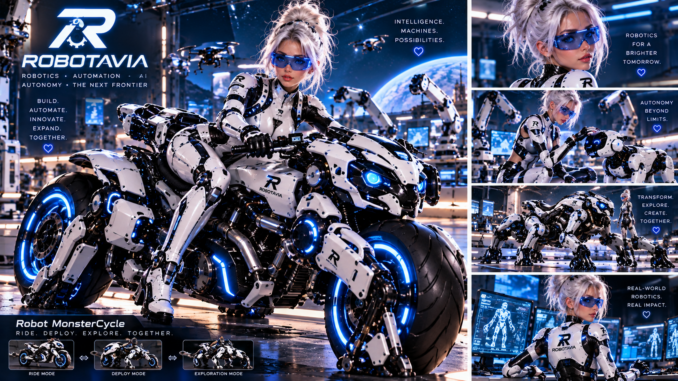

By Robotavia | Alluring Analysts — Robotics Stocks
November 4, 2026 | AnalyzeStocks.com
Stocks in Focus: Ouster (OUST), Teradyne (TER), XTEND AI Robotics (XTND)
The Robots Are Coming — and the Investment Race Is Already Underway!
Robots are moving beyond science-fiction movies and laboratory demonstrations.
They’re working in factories, navigating warehouses, inspecting infrastructure, transporting materials, and supporting increasingly sophisticated defense operations.
Artificial intelligence is helping machines interpret their surroundings, make decisions, and perform tasks with greater autonomy.
This convergence of robotics, advanced sensors, automation, and AI is frequently described as Physical AI.
And it is creating opportunities for companies developing the hardware and software that intelligent machines need.
Three publicly traded companies illustrate different parts of this emerging industry:
- Ouster (OUST): Giving autonomous machines the ability to perceive their surroundings.
- Teradyne (TER): Helping factories automate physical work with collaborative and mobile robots.
- XTEND AI Robotics (XTND): Developing software and robotic systems for autonomous defense and security operations.
Each company approaches robotics from a different direction.
But which businesses are demonstrating commercial progress, and which still face major financial challenges?
Robotavia is activating her research systems!
Ouster (OUST): Giving Robots the Power to See!
Ouster is becoming an increasingly interesting company in the world of Physical AI.
Its technologies include digital lidar sensors, cameras, AI computing capabilities, and perception software.
These systems help machines understand the physical environment around them.
Why Lidar Matters
Lidar uses laser light to measure distances and create detailed representations of surrounding objects and environments.
For autonomous machines, accurate perception is essential.
A warehouse robot must recognize obstacles.
An autonomous vehicle must detect nearby objects.
An industrial machine may need to navigate changing environments while maintaining safety.
Lidar can provide valuable information for these applications, particularly when combined with cameras and other sensors.
Ouster’s November 3 Earnings Surprise
On November 3, Ouster announced third-quarter 2026 financial results.
The company reported:
| Financial measure | Q3 2026 |
|---|---|
| Total revenue | $59.3 million |
| Year-over-year revenue growth | Approximately 50% |
| GAAP gross margin | 43% |
| GAAP net loss | $14 million |
| Adjusted EBITDA loss | $3 million |
| Cash and short-term investments, including restricted cash | Approximately $421 million |
Ouster also reported shipping more than 27,000 lidar and camera sensors during the quarter.
Lidar accounted for approximately 27% of those units.
The company described the period as its fifteenth consecutive quarter of product revenue growth.
These results suggest meaningful commercial momentum.
However, investors should examine the composition of that growth, including the contribution from acquisitions and the performance of different product categories.
Stereolabs Expands Ouster’s Capabilities
Ouster’s Stereolabs business adds camera-based perception technologies to its portfolio.
Combining lidar, computer vision, processing hardware, and software could allow Ouster to serve a wider range of robotics customers.
Potential applications include:
- Industrial automation.
- Warehouse robotics.
- Agricultural equipment.
- Autonomous delivery.
- Defense vehicles.
- Infrastructure monitoring.
The opportunity is significant, but competition is intense.
Ouster’s Fourth-Quarter Outlook
Management expects fourth-quarter 2026 revenue between $61 million and $64 million.
That guidance suggests continued sequential revenue growth if achieved.
But the company remains unprofitable under GAAP accounting.
Investors should watch whether higher sales translate into stronger margins, lower cash consumption, and sustainable profitability.
Robotavia’s Verdict on OUST
Ouster has demonstrated meaningful revenue growth and expanding product capabilities.
Its combination of lidar and camera-based perception technology gives it exposure to multiple Physical AI markets.
Robotavia’s Rating: HIGH-GROWTH ROBOTICS WATCHLIST.
The next challenge is converting commercial momentum into durable profitability.
Teradyne (TER): The Industrial Automation Powerhouse!
Teradyne offers a different investment profile.
The company is best known for semiconductor and electronic testing equipment, but it also owns important robotics businesses.
Its robotics operations include:
Universal Robots: Collaborative robotic arms, commonly called cobots.
Mobile Industrial Robots (MiR): Autonomous mobile robots designed to move materials through industrial facilities.
Unlike many early-stage robotics companies, Teradyne operates a large, established business with significant revenue and earnings.
What Are Collaborative Robots?
Traditional industrial robots often operate in highly controlled manufacturing environments.
Collaborative robots are designed for applications in which machines work alongside people, subject to appropriate safety controls.
They can help automate repetitive activities such as:
- Material handling.
- Machine tending.
- Assembly.
- Packaging.
- Inspection.
- Palletizing.
The goal is not simply replacing human labor.
Automation can also improve consistency, address labor shortages, and allow workers to concentrate on higher-value activities.
Teradyne’s Third-Quarter Results
On October 28, Teradyne reported third-quarter 2026 results.
| Financial measure | Q3 2026 |
|---|---|
| Total revenue | $1.306 billion |
| Year-over-year revenue growth | Approximately 70% |
| GAAP diluted EPS | $2.17 |
| Non-GAAP diluted EPS | $2.29 |
| Robotics segment revenue | $96 million |
The robotics business achieved its highest third-quarter revenue to date and reached profitability.
According to Teradyne’s quarterly filing, robotics revenue increased approximately 27.6% year over year.
Higher sales of collaborative robots and autonomous mobile robots supported the improvement.
The Important Distinction
Teradyne is not exclusively a robotics company.
Its semiconductor testing business represents a much larger portion of total revenue.
During the third quarter, Semiconductor Test generated approximately $1.072 billion, compared with $96 million from Robotics.
That means TER investors are receiving exposure to robotics alongside a substantial semiconductor-testing business.
The company’s overall performance may therefore be influenced more heavily by semiconductor demand than by robotics adoption alone.
Why Teradyne Matters
Teradyne provides a useful contrast with smaller speculative robotics stocks.
Its robotics operations have established commercial products, customers, and distribution networks.
The company also has the financial resources of a larger technology business.
However, investors still need to evaluate competition, industrial spending cycles, automation demand, and the valuation of the overall company.
Robotavia’s Verdict on TER
Teradyne offers exposure to industrial robotics through an established and profitable technology company.
Its robotics business is growing, but it remains a relatively small part of total operations.
Robotavia’s Rating: ESTABLISHED AUTOMATION WATCHLIST.
For investors interested in robotics without relying entirely on an early-stage company’s future, TER presents a different risk profile.
XTEND AI Robotics (XTND): Autonomous Machines Enter the Defense Arena!
XTEND AI Robotics operates in one of the most rapidly evolving segments of robotics: autonomous defense and security systems.
The company develops technology intended to coordinate robotic platforms across air, ground, and maritime environments.
Its central software platform is called the XTEND Operating System, or XOS.
The system is designed to connect autonomous machines, artificial intelligence, and human operators.
What Makes XTEND Different?
Many robotics companies specialize in manufacturing particular machines.
XTEND is pursuing a broader software-centered strategy.
Its operating system is intended to support different robotic platforms and mission requirements.
Potential applications include defense, homeland security, and commercial security operations.
The company emphasizes human-supervised autonomous capabilities rather than removing human oversight from every operation.
November 3: A New Defense Contract Milestone
On November 3, XTEND announced completion of deliveries under a $2.8 million defense contract in the Asia-Pacific region.
The announcement follows an October 28 report of a $2.35 million Middle East defense order involving XOS-powered SCORPIO 1000 systems.
These developments suggest continued commercial activity in the defense robotics market.
However, investors should distinguish contract announcements, completed deliveries, revenue recognition, and cash collections.
They are not interchangeable financial measures.
XTEND’s Preliminary Financial Results
On October 26, XTEND reported preliminary, unaudited results for the first nine months of 2026.
The company estimated:
| Preliminary measure | Nine months ended September 30, 2026 |
|---|---|
| Total revenue | $24.5 million–$26.5 million |
| AI Robotics segment revenue | $23 million–$24 million |
| AI Robotics segment backlog | Approximately $84 million |
The company expects to report full third-quarter financial results on November 16, 2026.
These figures are preliminary and subject to change.
The reported backlog is particularly interesting, but investors should evaluate its composition, expected delivery schedules, customer concentration, and cancellation provisions.
Backlog does not necessarily translate into immediate revenue or profit.
A Recently Public Company
XTEND began trading on the New York Stock Exchange under ticker XTND in September 2026 following a business combination with JFB Construction Holdings.
That transaction means investors should carefully examine the combined company’s financial statements and capital structure.
Historical results may not be directly comparable with the operations of the current business.
Share count, potential dilution, liquidity, and financing arrangements deserve particular attention.
The Defense Robotics Opportunity
Autonomous systems are attracting attention from governments and defense organizations seeking new capabilities.
Potential demand could support businesses developing robotic platforms, perception technologies, and mission-management software.
But the industry also faces significant risks.
Defense procurement can involve lengthy approval processes, political uncertainty, export restrictions, contract concentration, and changing government priorities.
Investors must also consider safety, accountability, and the legal and ethical requirements governing autonomous systems.
Robotavia’s Verdict on XTND
XTEND represents a speculative opportunity tied to autonomous defense technology.
Its announced contracts and preliminary backlog provide potential indicators of demand.
However, the company is newly public, and investors need additional audited financial information and evidence of sustainable operating performance.
Robotavia’s Rating: HIGH-RISK DEFENSE ROBOTICS WATCHLIST.
Commercial execution, capital structure, and financial transparency will be crucial.
Three Robotics Stocks, Three Different Business Models
| Company | Primary robotics exposure | Commercial position | Key concern |
|---|---|---|---|
| OUST | Lidar, cameras and Physical AI perception | Growing sensor and software business | Profitability and competition |
| TER | Collaborative and mobile industrial robots | Established, profitable parent company | Robotics is a minority of total revenue |
| XTND | Autonomous defense systems and software | Emerging public company with announced contracts | Execution, financial transparency and dilution |
These companies should not be evaluated using identical assumptions.
Ouster is focused on enabling machines to perceive the world.
Teradyne sells automation equipment used in industrial environments.
XTEND is developing software and systems for specialized autonomous operations.
Their revenue models, customers, competitive environments, and investment risks differ substantially.
Physical AI: The Next Big Technology Investment Theme?
Artificial intelligence has already transformed software.
The next challenge is applying AI to physical machines operating in unpredictable environments.
That requires more than powerful algorithms.
Autonomous systems need sensors, computing hardware, reliable communications, mechanical systems, and software capable of responding to real-world conditions.
This creates opportunities throughout the robotics supply chain.
The Building Blocks of Physical AI
Perception: Sensors and cameras that allow machines to detect their surroundings.
Decision-making: AI software that interprets information and selects actions.
Movement: Motors, actuators, robotic arms, and mobile platforms.
Control: Systems that coordinate tasks while maintaining safety and reliability.
Integration: Software and services connecting robots with industrial workflows.
Companies specializing in different parts of this ecosystem may benefit from broader robotics adoption.
But market growth does not guarantee that every participant will generate attractive shareholder returns.
Some companies may struggle with manufacturing costs.
Others may face aggressive competition or rapid technological change.
Early-stage businesses may require additional financing before achieving profitability.
And established companies may find that robotics growth remains too small to materially influence their overall earnings.
What Should Robotics Investors Watch?
Robotavia is tracking five indicators.
1. Revenue Growth
Are customers buying products and services at an increasing rate?
2. Gross Margins
Can companies produce and sell their technologies profitably before operating expenses?
3. Recurring Revenue
Are software, maintenance, and service relationships creating repeatable revenue?
4. Cash Flow
Can companies finance growth without excessive reliance on new share issuance?
5. Commercial Adoption
Are technologies moving beyond demonstrations into regular customer operations?
The strongest robotics businesses may ultimately be those capable of combining technical innovation with disciplined financial execution.
Robotavia’s Final Verdict: The Robotics Revolution Is Getting Real!
Robotics is no longer confined to research laboratories and futuristic predictions.
Autonomous systems are increasingly appearing in factories, warehouses, transportation networks, and specialized defense applications.
Ouster’s strong third-quarter revenue growth highlights demand for technologies that help machines perceive the world.
Teradyne’s profitable robotics segment demonstrates that industrial automation can support an established commercial business.
XTEND’s recent defense contract announcements illustrate growing interest in autonomous systems for specialized applications.
Together, these companies reveal the diversity of the robotics investment landscape.
But investors must separate technological excitement from financial reality.
A robot that performs an impressive demonstration is not automatically a profitable product. A growing backlog is not the same as collected cash. And a rapidly expanding industry does not guarantee that every robotics stock will succeed.
For investors searching for tomorrow’s automation leaders, the mission is clear:
Study the technology, follow customer adoption, examine the financial statements, and respect the risks.
Robotavia’s Robotics Watchlist: OUST, TER, XTND.
The machines are getting smarter.
The industry is expanding.
And Robotavia will be watching every sensor, every circuit, and every robot entering the real world!
— Robotavia, Alluring Analysts Robotics Stocks Specialist
Disclaimer: This article is provided for informational and educational purposes only and does not constitute personalized investment advice. Robotics and emerging technology stocks involve significant risks, including volatility, competition, financing needs, shareholder dilution, government procurement uncertainty, and potential loss of principal. Investors should conduct independent research before making investment decisions.