
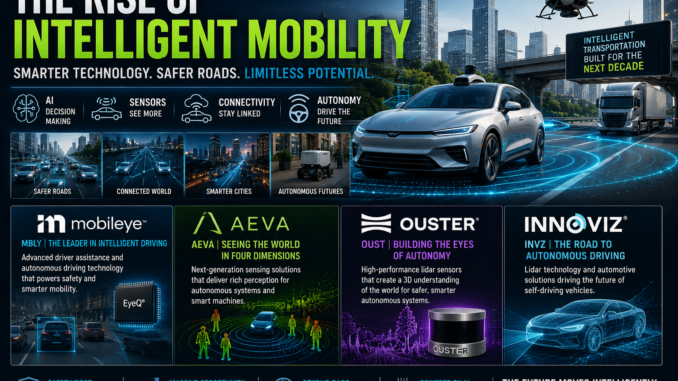

By AnalyzeStocks.com | June 2026
Artificial intelligence is transforming far more than chatbots and data centers.
It is transforming transportation.
Across the globe, vehicles are becoming smarter, safer, and increasingly autonomous. What was once considered science fiction is gradually becoming reality as sensors, machine vision, artificial intelligence, and advanced computing systems find their way into cars, trucks, drones, and future transportation networks.
This shift is creating one of the most important technology trends of the next decade:
Intelligent Mobility.
Transportation Is Becoming a Technology Industry
For most of automotive history, vehicle innovation focused on mechanical engineering.
More horsepower.
Better fuel economy.
Improved manufacturing.
Today’s vehicles increasingly resemble computers on wheels.
Modern transportation systems now depend on:
- Artificial intelligence
- Cameras
- Sensors
- Machine vision
- Edge computing
- Connectivity
- Real-time decision making
As a result, technology companies are becoming just as important as traditional automakers.
Mobileye (MBLY): The Leader in Intelligent Driving
Few companies are more closely associated with intelligent transportation than Mobileye.
The company has spent years developing advanced driver assistance systems and autonomous driving technologies.
Mobileye’s systems help vehicles:
- Detect obstacles
- Monitor traffic
- Assist drivers
- Improve safety
- Enable higher levels of automation
As more vehicles incorporate intelligent driving capabilities, Mobileye remains one of the most established players in the industry.
For investors seeking exposure to the rise of intelligent mobility, MBLY remains one of the most recognizable names.
Aeva (AEVA): Seeing the World in Four Dimensions
Autonomous systems require more than cameras.
They require the ability to understand distance, motion, and surroundings with incredible precision.
Aeva focuses on next-generation sensing technologies designed to provide richer environmental awareness.
Its technology helps machines better understand the world around them.
Whether the application involves:
- Autonomous vehicles
- Industrial automation
- Robotics
- Infrastructure monitoring
Advanced sensing remains a critical component of intelligent mobility.
Ouster (OUST): Building the Eyes of Autonomy
If artificial intelligence is the brain, sensors are the eyes.
Ouster specializes in lidar technology, which helps vehicles and machines create detailed maps of their surroundings.
Lidar has become one of the most important technologies in the autonomy ecosystem.
Applications continue expanding across:
- Transportation
- Robotics
- Industrial automation
- Smart infrastructure
- Security systems
As intelligent systems become more common, demand for environmental awareness technologies may continue growing.
Innoviz (INVZ): The Road to Autonomous Driving
Innoviz focuses specifically on lidar solutions for the automotive industry.
The company has pursued partnerships and development programs designed to support future autonomous driving platforms.
While competition remains intense, Innoviz represents another important participant in the race to make vehicles safer and smarter.
The path to full autonomy may take longer than many investors originally expected, but the long-term direction remains clear.
Vehicles continue becoming increasingly intelligent.
Why Intelligent Mobility Matters
Several technology revolutions are converging simultaneously.
Artificial Intelligence
AI enables real-time decision making and advanced automation.
Sensor Technology
Machines must understand their environment before they can safely navigate it.
Connectivity
Vehicles increasingly communicate with networks, infrastructure, and cloud systems.
Computing Power
Modern autonomous systems require enormous processing capabilities.
Together, these technologies create the foundation for intelligent mobility.
Beyond Self-Driving Cars
Many investors focus solely on autonomous passenger vehicles.
However, intelligent mobility extends far beyond that market.
Applications include:
- Commercial trucking
- Warehouse automation
- Industrial robotics
- Smart cities
- Infrastructure monitoring
- Security systems
- Delivery networks
This broader opportunity may ultimately become larger than autonomous cars alone.
The Long Road Ahead
Autonomous transportation remains a long-term opportunity.
Challenges remain:
- Regulation
- Safety validation
- Infrastructure development
- Consumer adoption
However, progress continues.
The goal is no longer simply moving people from one place to another.
The goal is creating transportation systems that can see, think, learn, and respond.
That transition has already begun.
Final Thoughts
The Rise of Intelligent Mobility represents one of the most important intersections of artificial intelligence, sensors, software, and transportation.
Companies like Mobileye, Aeva, Ouster, and Innoviz are helping build the technologies that allow machines to understand and navigate the world.
The timeline may be longer than many expected.
The path may not be linear.
But the direction remains clear.
Transportation is becoming smarter.
Vehicles are becoming more capable.
And intelligent mobility may become one of the defining technology trends of the next decade.
Scorecard
Innovation
★★★★★
Combines AI, sensors, software, and transportation into a rapidly evolving technology ecosystem.
Sector Importance
★★★★★
Smarter transportation has the potential to impact nearly every industry.
Future Potential
★★★★★
Autonomous systems remain one of the largest long-term opportunities in technology.
Moonshot Energy
★★★★★
Intelligent mobility represents the convergence of multiple Moonshot themes into a single transformative trend.
