

By AnalyzeStocks.com | June 2026
When investors think about artificial intelligence, they usually picture data centers, cloud computing, robots, and self-driving cars.
Few think about the ocean.
That may be a mistake.
Covering more than 70% of the Earth’s surface, the oceans remain one of the least explored environments on the planet. At the same time, advances in artificial intelligence, sensors, robotics, satellite networks, and autonomous systems are creating new opportunities to understand and manage marine environments.
The result is a growing technology trend that could eventually become one of the most fascinating frontiers of artificial intelligence:
Ocean AI.
Why the Ocean Matters
The ocean supports global trade, energy production, communications, environmental monitoring, fisheries, and national security.
Yet vast portions remain poorly mapped and sparsely monitored.
For decades, gathering ocean data has been expensive and difficult.
Artificial intelligence is beginning to change that.
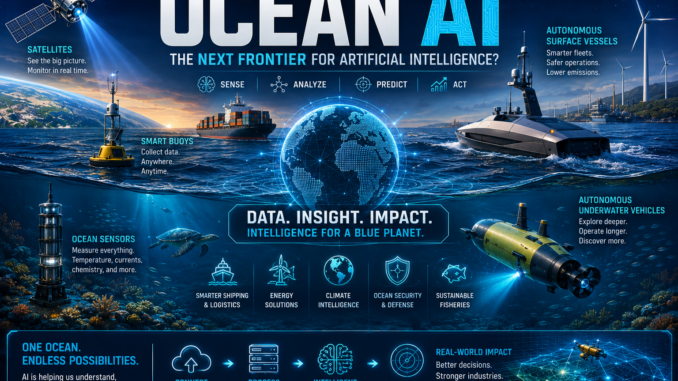
Modern systems can now process enormous amounts of information collected from:
- Satellites
- Autonomous vessels
- Ocean sensors
- Underwater drones
- Weather systems
- Shipping networks
The ability to analyze this information in real time could transform how we interact with the world’s oceans.
The Rise of Autonomous Ocean Systems
Just as autonomous vehicles are changing transportation on land, autonomous systems are beginning to appear at sea.
Emerging technologies include:
- Uncrewed surface vessels
- Autonomous underwater vehicles
- Smart buoy networks
- AI-powered monitoring platforms
These systems can operate continuously while collecting valuable data across vast areas.
Artificial intelligence helps these platforms identify patterns, detect anomalies, and make decisions without constant human oversight.
Ocean AI and Climate Intelligence
One of the most important applications for Ocean AI involves environmental monitoring.
The oceans influence:
- Weather patterns
- Hurricanes
- Fisheries
- Coastal ecosystems
- Global temperatures
Artificial intelligence can help scientists analyze enormous datasets and identify trends that might otherwise remain hidden.
Improved forecasting and environmental awareness could benefit governments, businesses, and communities around the world.
AI-Powered Shipping and Logistics
More than 80% of global trade moves by sea.
Artificial intelligence is increasingly being used to improve:
- Shipping routes
- Fuel efficiency
- Fleet management
- Port operations
- Cargo tracking
As maritime industries adopt AI-driven systems, efficiency gains could create significant economic benefits.
The ocean remains one of the largest transportation networks on Earth.
Energy Opportunities Beneath the Surface
The oceans also play an important role in global energy production.
Artificial intelligence may help improve:
- Offshore wind operations
- Marine energy systems
- Underwater infrastructure monitoring
- Energy transportation networks
As the world demands more energy, AI-enabled systems may become critical tools for managing increasingly complex infrastructure.
Ocean Security and Defense
National security organizations are investing heavily in technologies capable of monitoring and protecting maritime environments.
Potential applications include:
- Autonomous surveillance
- Threat detection
- Underwater monitoring
- Infrastructure protection
Artificial intelligence can help process vast quantities of information far faster than traditional methods.
This may become one of the largest long-term drivers of Ocean AI adoption.
The Infrastructure Behind Ocean AI
Like every major AI trend, Ocean AI depends on infrastructure.
It requires:
- Satellites
- Sensors
- Networks
- Data centers
- Cloud computing
- Edge processing systems
The companies building these technologies may ultimately become some of the biggest beneficiaries of the trend.
Ocean AI is not simply an ocean story.
It is also an infrastructure story.
A New Frontier
Many of today’s technology leaders focus on land-based opportunities.
Yet the oceans represent one of the largest untapped environments available for technological innovation.
Artificial intelligence provides a way to collect, analyze, and act on information at a scale that was previously impossible.
The opportunity spans:
- Transportation
- Energy
- Defense
- Environmental monitoring
- Communications
- Infrastructure
Few emerging technology themes offer such broad potential.
Final Thoughts
Artificial intelligence is expanding into nearly every industry.
The oceans may be next.
Ocean AI combines several powerful trends:
- Artificial intelligence
- Robotics
- Sensors
- Satellite technology
- Infrastructure
- Automation
Together, they create a vision of a smarter, more connected ocean economy.
The technology remains early.
The opportunity remains large.
And for investors looking beyond the obvious AI stories, Ocean AI may represent one of the most interesting frontiers of the next decade.
Scorecard
Innovation
★★★★★
Combines AI, robotics, satellites, and marine technology into a unique emerging sector.
Sector Importance
★★★★☆
The oceans impact trade, energy, security, and environmental systems worldwide.
Future Potential
★★★★★
Ocean AI could create entirely new industries and applications over time.
Moonshot Energy
★★★★★
One of the most overlooked and potentially exciting frontiers in artificial intelligence.
