

Computing, Security, Sensors, Infrastructure, and the Companies Building the Quantum Revolution
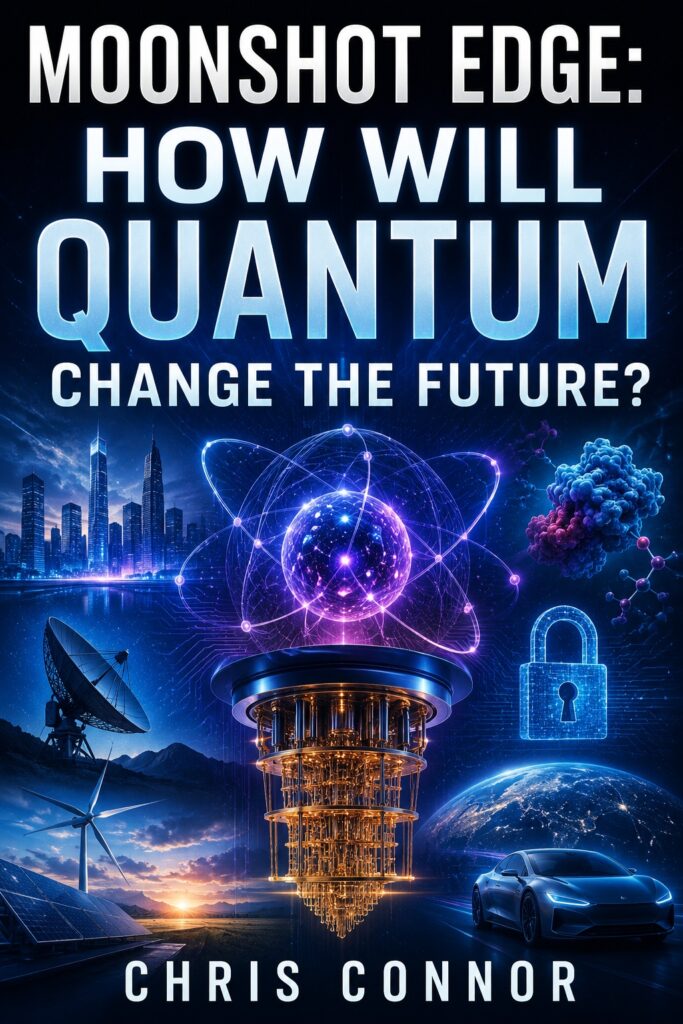
📖 Available Now on Amazon
Introduction
What if the next technological revolution isn’t artificial intelligence?
What if it’s the technology that eventually makes artificial intelligence even more powerful?
For years, quantum computing has been discussed as a futuristic concept that always seemed just out of reach. The headlines often sound incredible. Quantum computers that could solve problems impossible for today’s machines. New medicines discovered faster. Advanced materials designed on a computer before they ever exist in the real world. Cybersecurity systems built to withstand future threats. Navigation systems that work without GPS. Entire industries transformed by a new way of processing information.
The challenge is that most people still don’t understand what quantum computing actually is.
Many investors hear terms like qubits, superposition, entanglement, and quantum networking and immediately tune out. Others assume quantum computing is simply a faster version of today’s computers. The reality is much more interesting.
Quantum computing is not about replacing your laptop, smartphone, or cloud server. It is about solving specific types of problems that traditional computers struggle to solve. Some of those problems involve chemistry. Others involve optimization, cybersecurity, navigation, artificial intelligence, logistics, energy, and scientific discovery.
In many ways, quantum computing today feels similar to artificial intelligence a decade ago.
Back then, AI was often viewed as an experimental technology with uncertain commercial applications. Today, AI has become one of the most important investment themes in the world. Entire industries have emerged around AI, creating opportunities not only for software companies but also for chipmakers, memory providers, data centers, networking companies, cybersecurity firms, and infrastructure providers.
Quantum computing may follow a similar path.
That is one of the reasons I decided to write this book.
Most discussions about quantum technology focus on a handful of stocks or a single breakthrough announcement. While those stories are important, they often miss the bigger picture. The real opportunity may not be limited to one company or even one technology.
The quantum revolution is creating an entire ecosystem.
Some companies are building quantum computers.
Others are developing software platforms that make quantum systems usable.
Others are focused on quantum-resistant cybersecurity solutions designed to protect information in a future where quantum computers become powerful enough to challenge today’s encryption methods.
Still others are working on quantum sensors, atomic clocks, advanced navigation systems, networking technologies, and infrastructure that could support the next generation of computing.
This broader ecosystem is where things become truly fascinating.
Throughout this book, we’ll explore not only the companies attempting to build the future of quantum computing, but also the industries and technologies that may benefit from its growth. We’ll examine how quantum computing could impact healthcare, artificial intelligence, cybersecurity, national defense, finance, climate science, energy storage, and many other areas of the economy.
We’ll also discuss the risks.
Quantum remains one of the most speculative sectors in technology. Many companies will fail. Some technologies may never reach their full potential. Timelines will likely take longer than investors hope. Understanding those risks is just as important as understanding the opportunities.
But history has shown that transformative technologies often look confusing, expensive, and uncertain in their early years.
The internet did.
Artificial intelligence did.
And quantum computing does today.
The future is rarely obvious while it is being built.
That is what makes this moment so interesting.
The race is already underway. Governments are investing billions. Researchers are making breakthroughs. Companies are forming partnerships. Investors are beginning to pay attention.
The question is no longer whether quantum technology matters.
The question is how much it will matter.
And perhaps more importantly…
How will quantum change the future?
— Chris Connor
