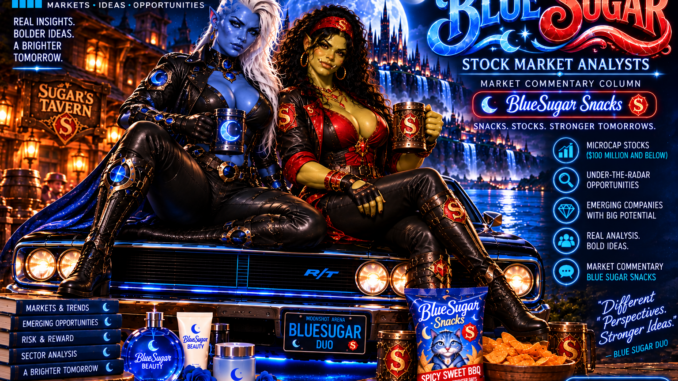

By BLUE SUGAR — Zarka Moon & Sugar
Alluring Analysts | AnalyzeStocks.com | November 5, 2026
Two women. One market. Different Perspectives. Stronger Ideas!
Welcome Back to Sugar’s Tavern!
The blue lanterns are glowing over Gothic Gem, the music is playing, and Sugar’s Tavern is alive with conversation.
Behind the counter, Sugar is studying a collection of stock charts while Zarka Moon reviews the latest election results.
Sugar: “Well, Zarka, it looks like Washington just got turned upside down. The Democrats won Congress, Wall Street threw a party, and half my watchlist can’t decide whether to celebrate or panic.”
Zarka: “That’s a fair description of the market reaction. But I wouldn’t confuse a one-day rally with a permanent change in investment fundamentals.”
Sugar: “And here I thought you were going to let me enjoy the excitement for five minutes.”
Zarka: “You can enjoy it. Just don’t mistake excitement for analysis.”
Sugar: “Fine. Pour yourself something blue and tell me which stocks might actually benefit from this election.”
Zarka: “Now that’s a question worth investigating.”
Welcome back to BlueSugar Snacks, where two women bring different perspectives to the same investment opportunities.
Today’s special? The 2026 midterm elections, served with a generous helping of market volatility.
1. The Midterm Election Shake-Up
The November 3, 2026, elections delivered a major political shift.
Democrats won control of both the House of Representatives and the Senate, ending Republican control of Congress.
President Donald Trump remains in the White House, creating a divided federal government beginning in January 2027.
The results could affect expectations for government spending, regulation, energy policy, healthcare, artificial intelligence, and taxation.
But there’s an important distinction between winning an election and implementing new policies.
Sugar: “So the Democrats control Congress, but Trump is still president. That sounds like a recipe for some interesting arguments.”
Zarka: “It certainly creates opportunities for disagreement. But it also means major legislation may require compromise.”
Sugar: “You mean politicians might actually have to work together?”
Zarka: “Let’s not make predictions we can’t support.”
Sugar laughs and slides a blue drink across the counter.
Sugar: “Fair enough. How did Wall Street take the news?”
On November 4, the major U.S. stock indexes rallied sharply.
| Index | November 4 performance |
|---|---|
| Dow Jones Industrial Average | Approximately +3.0% |
| S&P 500 | Approximately +1.6% |
| Nasdaq Composite | Approximately +1.4% |
| Russell 2000 | Approximately +1.6% |
Investors appeared relieved that election uncertainty had diminished, while falling oil prices and Treasury yields also supported sentiment.
However, the broad rally concealed significant differences between industries.
Zarka: “The market wasn’t simply celebrating one political party. Investors were adjusting their expectations for individual businesses.”
Sugar: “Then let’s find out who got the sweetest deal.”
2. Solar Stocks: A Brighter Political Forecast?
Solar and renewable-energy companies were among the most visible beneficiaries of the election results.
Investors anticipated that Democratic control of Congress could help preserve federal support for renewable-energy development.
Among the stocks worth watching:
First Solar (NASDAQ: FSLR)
First Solar manufactures solar modules and has significant exposure to the U.S. renewable-energy market.
Its shares gained approximately 5% on November 4 as investors reassessed the political outlook for clean energy.
Enphase Energy (NASDAQ: ENPH)
Enphase develops microinverters and energy-management technology used in residential solar installations.
Its prospects depend on consumer demand, financing conditions, equipment pricing, and installation activity.
NextEra Energy (NYSE: NEE)
NextEra combines regulated utility operations with significant renewable-energy development.
Its business model differs considerably from those of solar equipment manufacturers.
Sugar: “Now this is interesting. Solar stocks are getting a little sunshine after a rough stretch.”
Zarka: “Political support can improve expectations, but we should separate that from the financial condition of each company.”
Sugar: “You’re telling me a company can have Washington on its side and still be a lousy investment?”
Zarka: “Absolutely. High debt, weak margins, and excessive valuations don’t disappear after an election.”
Sugar: “Then maybe we should look at First Solar and Enphase separately instead of tossing every solar company into the same basket.”
Zarka: “Exactly. They face different competitive pressures and have different financial profiles.”
Blue Sugar’s Take
Renewable-energy companies could benefit from a more favorable legislative environment, but investors should examine profitability, balance sheets, and project economics before treating an election rally as a buying signal.
3. Artificial Intelligence: The Data-Center Debate Gets Political
The AI revolution has created enormous demand for computing power, electricity, networking equipment, and specialized infrastructure.
But the election highlighted growing political concerns about data-center development.
Communities across the country are questioning the impact of massive facilities on electricity prices, water resources, and local infrastructure.
Some candidates campaigning on stronger oversight of data-center expansion won important elections.
Investors responded by selling shares of several AI infrastructure companies.
| Company | Ticker | Investment consideration |
|---|---|---|
| CoreWeave | CRWV | AI cloud infrastructure and financing |
| Applied Digital | APLD | Data-center construction and power availability |
| IREN | IREN | Computing infrastructure and electricity economics |
| Microsoft | MSFT | AI services, cloud demand, and capital spending |
| Alphabet | GOOGL | AI development, cloud infrastructure, and profitability |
Sugar: “Wait a minute. Everybody wants artificial intelligence, but now they’re arguing about where to put the computers?”
Zarka: “That’s one way to describe it.”
Sugar: “Well, those computers have to live somewhere.”
Zarka: “And building their homes requires electricity, land, financing, cooling systems, and government approvals.”
Sugar: “Sounds more complicated than opening another tavern.”
Zarka: “Considerably. And the companies financing those facilities may be more vulnerable to construction delays than established technology giants.”
Sugar: “So Microsoft might handle a delay better than a smaller company that’s borrowing heavily to build its next data center?”
Zarka: “Potentially. Microsoft has substantial existing businesses and financial resources. A smaller infrastructure developer may depend more heavily on timely project completion.”
Sugar: “That’s the kind of distinction I like. Same AI boom, very different risks.”
The election doesn’t eliminate demand for AI computing.
But it could increase scrutiny of the costs and consequences of expanding AI infrastructure.
Blue Sugar’s Take
Investors should distinguish between companies developing profitable AI applications, established cloud providers, and infrastructure developers requiring substantial financing.
Political opposition to data-center construction may affect those businesses differently.
4. Defense Stocks: A New Budget Battle
Defense contractors faced selling pressure after the elections.
Investors began considering whether a Democratic-controlled Congress might challenge President Trump’s proposed defense spending increases.
Major companies affected by changing defense-budget expectations include:
- Lockheed Martin (NYSE: LMT) — Fighter aircraft, missiles, and defense systems.
- Northrop Grumman (NYSE: NOC) — Aerospace, strategic systems, and military technology.
- RTX Corporation (NYSE: RTX) — Defense electronics, missiles, and aerospace systems.
Sugar: “I noticed defense stocks weren’t celebrating with everybody else. Did the election suddenly make the world peaceful?”
Zarka: “Unfortunately, no. The concern is about future spending priorities and negotiations over defense budgets.”
Sugar: “But these companies already have contracts, don’t they?”
Zarka: “Many do. Defense programs often span years, and existing backlogs can provide revenue visibility.”
Sugar: “Then investors shouldn’t assume one election wipes out years of business.”
Zarka: “Correct. But they also shouldn’t assume every proposed spending increase will become law.”
The distinction matters.
A defense contractor’s value depends on its existing contracts, future orders, execution, margins, and long-term demand.
Changes in congressional leadership may influence those factors without immediately transforming the business.
Blue Sugar’s Take
Defense stocks could experience additional volatility as investors reassess future budgets. However, existing contracts and long-term national security requirements remain important considerations.
5. Energy Stocks: Oil Prices Change the Conversation
Traditional energy companies faced another challenge as oil prices declined sharply.
The election raised questions about future foreign policy, including the conflict involving Iran, while investors also considered the broader outlook for global energy markets.
Among the companies to monitor:
Exxon Mobil (NYSE: XOM)
Chevron (NYSE: CVX)
ConocoPhillips (NYSE: COP)
Sugar: “Let me get this straight. Solar stocks are rising, oil prices are falling, and everybody’s trying to figure out what Washington does next.”
Zarka: “That’s part of the story. But oil prices depend on global supply, demand, production decisions, and geopolitical developments.”
Sugar: “So we shouldn’t blame every movement in crude oil on the election.”
Zarka: “Exactly. The election may influence expectations, but it doesn’t control the global energy market.”
Sugar: “And falling oil prices aren’t necessarily bad for everybody.”
Zarka: “Good point. Airlines, transportation companies, and other fuel-intensive businesses may benefit from lower energy costs.”
Sugar: “Now that’s interesting. One industry’s problem can become another industry’s opportunity.”
Blue Sugar’s Take
Energy investors should monitor commodity prices, production costs, balance sheets, and cash generation rather than making investment decisions based solely on political expectations.
6. Healthcare and Consumer Stocks: The Overlooked Winners?
While attention focused on solar, AI, and defense, another group of companies attracted investors.
Healthcare businesses and retailers serving budget-conscious consumers rallied as markets considered the potential implications of the election for healthcare funding and household spending.
Democratic congressional control could complicate proposed reductions in certain federal healthcare and assistance programs.
That possibility may improve expectations for some companies serving lower-income households.
But the actual outcome will depend on future negotiations and legislation.
Sugar: “Now we’re getting somewhere. Everybody’s watching the big technology companies, but the election could affect businesses that ordinary families use every day.”
Zarka: “Precisely. Healthcare funding, consumer purchasing power, and government assistance can influence corporate revenue.”
Sugar: “So a discount retailer or healthcare provider might benefit without ever being part of the election headlines.”
Zarka: “Potentially. But the details matter. Different healthcare companies have very different reimbursement models and regulatory exposure.”
Sugar: “And retailers still need customers who can afford to shop.”
Zarka: “Exactly.”
Blue Sugar’s Take
Healthcare and consumer-oriented businesses deserve attention, but investors should distinguish between anticipated policy benefits and improvements already visible in financial results.
7. Five Questions Before Trading the Election
Sugar takes another look at the market charts.
Sugar: “All right, Zarka. We’ve got solar stocks rising, AI infrastructure getting nervous, defense contractors slipping, and consumer companies attracting buyers. How do we sort through all of this?”
Zarka: “By asking better questions.”
Together, the Blue Sugar Duo identifies five considerations.
1. Has the election actually changed the company’s business outlook?
A change in investor sentiment doesn’t necessarily mean a company’s earnings potential has changed.
2. Does the company depend on government spending or regulation?
Businesses heavily exposed to federal budgets, incentives, or permits may be more sensitive to policy changes.
3. Is the market reaction already reflected in the stock price?
Even favorable developments can become poor investments if expectations are too optimistic.
4. Can the company withstand delays or uncertainty?
Cash reserves, debt obligations, and operating cash flow can become especially important during periods of political change.
5. What would make the investment thesis wrong?
A strong investment argument should identify the conditions that could invalidate it.
Sugar: “I like that last one. It’s easy to find reasons to buy something when you’re already excited about it.”
Zarka: “And much harder to identify the evidence that would make you change your mind.”
Sugar: “That’s why I keep you around. You make me think before I spend my money.”
Zarka: “And you make sure we don’t overlook opportunities simply because they’re unconventional.”
Sugar smiles.
Sugar: “Different perspectives, stronger ideas. Imagine that.”
The Blue Sugar Showdown: Buy the Election, or Buy the Business?
Sugar: “Time for our final verdict. If a stock gets hammered after an election, should investors go bargain hunting?”
Zarka: “They can investigate. But a falling share price isn’t proof of undervaluation.”
Sugar: “Suppose a company has strong earnings, manageable debt, and a growing business, but investors are selling because they’re nervous about Washington.”
Zarka: “That could be worth examining. Especially if the expected policy changes are unlikely to affect the company’s long-term profitability.”
Sugar: “And if the company depends on subsidies that might disappear?”
Zarka: “Then investors need to understand how much of its business model depends on those subsidies.”
Sugar: “What about AI infrastructure companies? Some of those stocks have taken a beating.”
Zarka: “I’d compare financing needs, construction commitments, customer contracts, and power availability before making any decision.”
Sugar: “So your answer is to do the homework.”
Zarka: “Usually.”
Sugar: “You know, Zarka, that might be the least exciting answer in the history of Sugar’s Tavern.”
Zarka: “It’s also one that can save investors a great deal of money.”
Sugar laughs and raises her glass.
Sugar: “Then here’s to finding opportunities without getting carried away by the headlines.”
Zarka: “I’ll drink to that.”
Final Verdict: Elections Change Expectations, but Businesses Create Value
The 2026 midterm elections delivered a significant change in Washington.
Democrats won control of both chambers of Congress, setting the stage for divided government in 2027.
Wall Street initially responded with a broad rally, but individual sectors experienced very different reactions.
Renewable-energy companies attracted buyers. AI infrastructure developers faced questions about future expansion. Defense contractors confronted uncertainty over spending priorities. Traditional energy companies responded to falling oil prices, while healthcare and consumer-oriented businesses found reasons for optimism.
Yet the election itself doesn’t determine which companies will produce attractive long-term investment returns.
That depends on earnings, cash flow, valuations, competitive advantages, management decisions, and the policies that ultimately become reality.
Sugar: “Well, Zarka, the election gave us plenty to talk about. I have a feeling the next few months will be just as interesting.”
Zarka: “They probably will. But I’d rather spend those months studying businesses than trying to predict every political argument.”
Sugar: “Fair enough. You handle the financial statements, I’ll keep an eye out for interesting opportunities, and we’ll compare notes right here at the tavern.”
Zarka: “Sounds like a plan.”
Outside, the blue lanterns sway gently in the evening breeze as the two women return to their research.
Another lively discussion at Sugar’s Tavern has come to an end, but the market will provide plenty more stories.
BLUE SUGAR — Zarka Moon & Sugar
Alluring Analysts | AnalyzeStocks.com
Different Perspectives. Stronger Ideas!
Sources and Further Reading
- Associated Press — November 2026 midterm election results and congressional control.
- Reuters — November 4, 2026, U.S. stock-market reaction and sector performance.
- Fidelity — 2026 Midterm Elections: What’s Next?, November 4, 2026.
- State Street Global Advisors — The Morning After the Midterms, November 4, 2026.
Disclaimer: This article is for informational and educational purposes only. It does not constitute personalized investment advice or an endorsement of any political party or candidate. Election-related market reactions can reverse quickly. Investors should independently evaluate company fundamentals, valuations, and financial risks before making investment decisions.