


Sometimes an investing idea starts with a stock.
Sometimes it starts with an industry.
And sometimes two completely different ways of looking for opportunity collide.
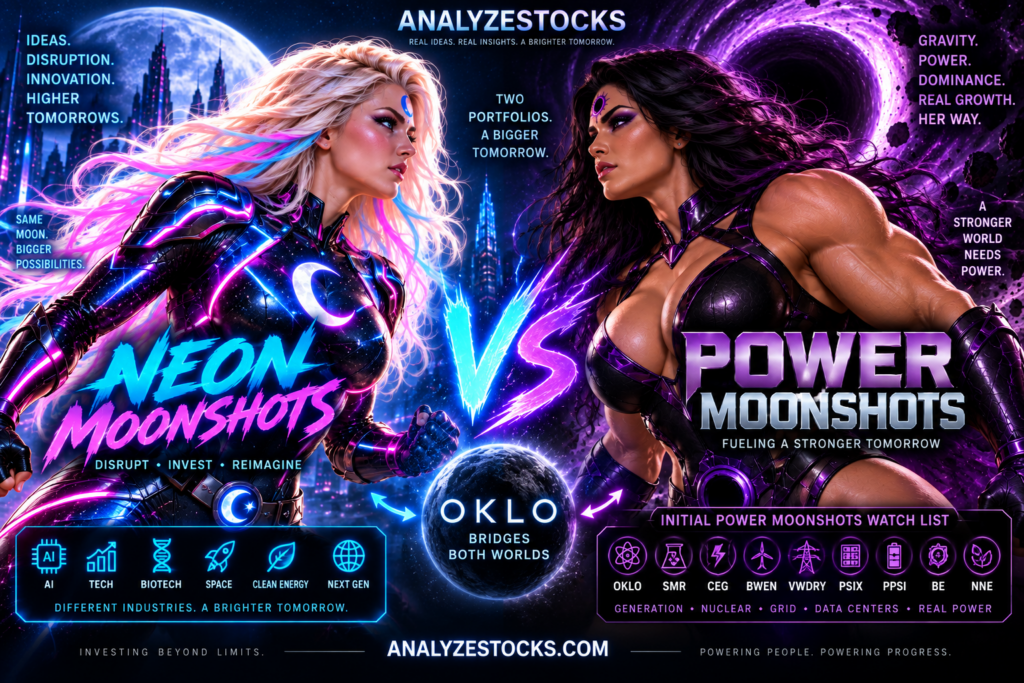
Welcome to Neon Moonshots vs. Power Moonshots.
At AnalyzeStocks, we recently introduced the Neon Moonshots portfolio as a place to hunt for companies with the potential to participate in the next generation of innovation and growth. The idea isn’t restricted to one sector. A Neon Moonshot can emerge from technology, communications, cybersecurity, infrastructure, digital assets or another industry where change may create significant opportunity.
Now we’re adding a second hunting ground.
Power Moonshots.
The premise is simple: the world is going to need power.
Lots of it.
Artificial intelligence and data centers are increasing electricity requirements. Manufacturing and infrastructure need dependable power. The electrical grid requires investment and modernization. Nuclear power has returned to the investing conversation. Distributed generation is becoming increasingly important.
Instead of trying to predict one single winner from all of those trends, Power Moonshots will hunt across the electricity ecosystem.
And one stock already demonstrates why these two portfolios can overlap.
OKLO: One Stock, Two Worlds
Oklo (OKLO) is where Neon Moonshots and Power Moonshots meet.
From the Neon perspective, OKLO represents the type of disruptive opportunity that portfolio was designed to investigate: a company attempting to commercialize an advanced approach in an enormous existing industry.
From the Power perspective, the connection is even more direct.
It’s about electricity.
That makes OKLO an excellent example of an important principle behind these portfolios: our categories don’t have to be mutually exclusive.
A company can potentially be innovative enough for Neon Moonshots while simultaneously participating directly in the growing demand for power.
The Power Moonshots list begins with OKLO at $38.00 in our portfolio snapshot. The stock’s displayed 52-week range stretches from $34.38 to $193.84, illustrating just how volatile these emerging themes can become.
That volatility is also why a Moonshot label should never be confused with an automatic buy signal.
We’re hunting first.
Then we’re doing the work.
What Makes a Neon Moonshot?
Neon Moonshots is intentionally broad.
We aren’t looking for twelve companies that all do the same thing. We’re looking across industries for businesses that may benefit from technological change, disruption, new markets and long-term shifts in how the economy operates.
The current Neon Moonshots portfolio consists of:
CleanSpark (CLSK), Cadre Holdings (CDRE), Digi International (DGII), Impinj (PI), MaxLinear (MXL), Box (BOX), Varonis Systems (VRNS), Commvault Systems (CVLT), Dropbox (DBX), CoreWeave-related spinoff CTRI, Tutor Perini (TPC), and MYR Group (MYRG).
That is an intentionally unusual collection.
The portfolio doesn’t depend upon one industry becoming the next big thing. Instead, we’re looking for individual opportunities across different parts of the market.
Some will work.
Some won’t.
Some may remain interesting without ever becoming attractive enough to buy.
And occasionally we may find one that develops into something much bigger than we initially expected.
That’s the hunt.
Power Moonshots Has a Different Mission
Power Moonshots starts from a different question:
Who benefits if electricity becomes one of the defining investment themes of the next decade?
We’re not limiting that question to utilities.
We’re looking at companies involved in generation, nuclear technology, distributed power, grid infrastructure, equipment, wind power, data-center electricity requirements and other businesses positioned somewhere along the expanding power chain.
Our initial Power Moonshots hunting list contains nine stocks:
Oklo (OKLO), NuScale Power (SMR), Constellation Energy (CEG), Broadwind (BWEN), Vestas Wind Systems (VWDRY), Power Solutions International (PSIX), Pioneer Power Solutions (PPSI), Bloom Energy (BE), and NANO Nuclear Energy (NNE).
That’s the starting lineup.
It is not nine buy recommendations.
In fact, that’s one reason we’re launching the portfolio now. We want a defined universe that we can follow, research, compare and refine as opportunities develop.
Some names may eventually earn investment.
Others may disappear from the list.
And companies that aren’t even on our radar today may eventually become some of our favorite Power Moonshots.
The Power List Already Shows How Different These Companies Are
Even a quick look at the initial group shows why we don’t want to reduce the power theme to a single industry.
OKLO and SMR put advanced nuclear technology near the center of the conversation.
CEG represents a very different type of exposure through an established electricity-generation business.
NNE brings another speculative nuclear angle.
BE provides exposure to distributed power technology.
BWEN and VWDRY bring wind-related businesses into the hunt.
PSIX and PPSI expand the search into power systems and equipment.
Those are very different businesses attempting to participate in different pieces of the same enormous underlying requirement:
The world needs electricity.
The initial snapshot also demonstrates the enormous range of market behavior inside the theme. Prices in the Power Moonshots list range from PPSI at $3.51 to BE at $265.63, while several of the nuclear-oriented names have experienced extremely wide 52-week trading ranges.
This isn’t one trade.
It’s an investing landscape.
Neon Hunts Disruption. Power Hunts Electricity.
That’s the easiest way to understand the difference.
Neon Moonshots asks:
Where is the next disruptive opportunity?
Power Moonshots asks:
Who could benefit from the enormous amount of electricity the future may require?
Those questions can lead us to completely different stocks.
But occasionally they’ll lead us to the same one.
That’s why OKLO is such an interesting bridge between the two portfolios.
It doesn’t mean OKLO will ultimately succeed. It doesn’t mean its current valuation is attractive. And it certainly doesn’t eliminate the substantial risks associated with an emerging company attempting to commercialize advanced nuclear technology.
It simply means the investment thesis can be examined through two different lenses.
That’s exactly what we want these portfolios to do.
A Portfolio Is More Than a List of Tickers
One thing we’re deliberately avoiding with Power Moonshots is creating a flashy list of power stocks and pretending the research is finished.
The list is where the research starts.
We’ll be watching fundamentals.
We’ll be watching valuations.
We’ll be watching execution.
We’ll be watching which technologies actually attract customers and capital.
And we’ll be watching price.
A fascinating company can still be a terrible investment at the wrong price. Likewise, a stock the market has abandoned can become much more interesting if the underlying business remains intact.
The portfolio gives us a permanent place to conduct that hunt.
Two Portfolios. Two Missions. One Bigger Hunt.
There’s also something fun happening here.
Readers of AnalyzeStocks will see Neon Moonshot and Power Moonshot facing each other across our feature image.
Those characters come from the expanding Forbidden Beyond fictional universe, where Neon Moonshot and Power Moonshot are becoming rivals.
But here on AnalyzeStocks, that rivalry takes on an entirely different meaning.
Neon Moonshots represents disruption, innovation and the search across industries for tomorrow’s opportunities.
Power Moonshots represents electricity, infrastructure, generation and the companies trying to power that tomorrow.
The fictional rivalry begins in Forbidden Beyond.
The stock rivalry begins right here on AnalyzeStocks.
And unlike the characters, these portfolios don’t actually need to destroy each other.
Sometimes they might even want the same stock.
Just ask OKLO.
Power Moonshots is a new AnalyzeStocks research/watchlist concept. Inclusion in either portfolio or watchlist does not constitute a recommendation to buy or sell a security. Investors should conduct their own research and consider their individual objectives and risk tolerance before making investment decisions.
