

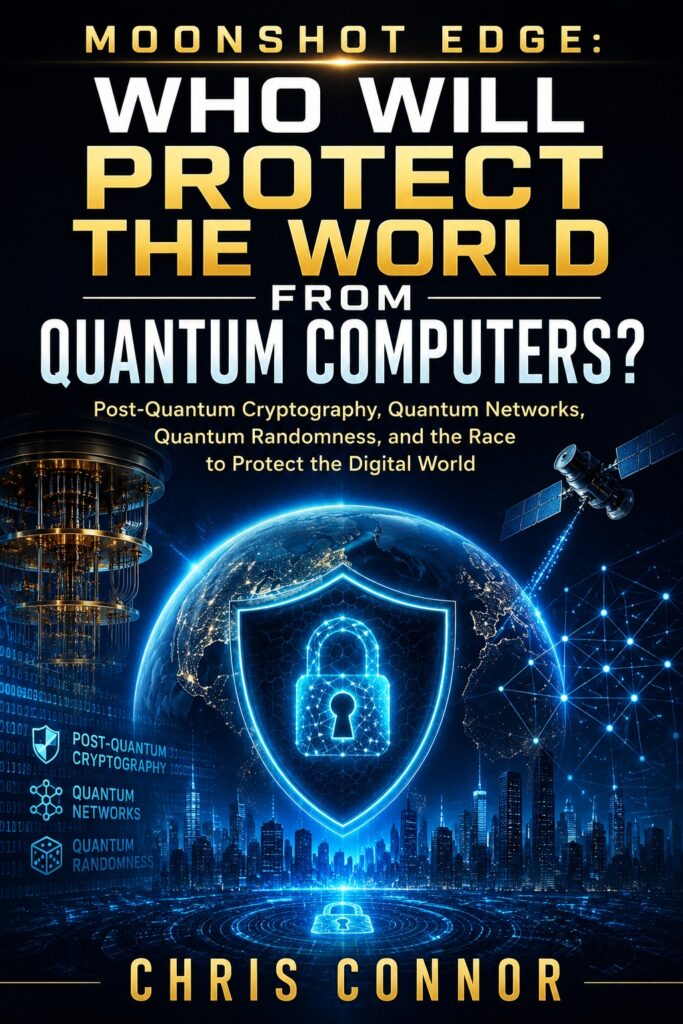
Post-Quantum Cryptography, Quantum Networks, Quantum Randomness, and the Race to Protect the Digital World
📖 Available Now on Amazon
Introduction
What if the greatest threat to tomorrow’s digital world is being created by one of humanity’s greatest technological achievements?
Quantum computing promises to revolutionize nearly every industry imaginable. Scientists hope it will accelerate medical breakthroughs, improve artificial intelligence, optimize global logistics, discover new materials, strengthen national defense, and solve scientific problems that would take today’s most powerful supercomputers thousands of years to complete.
But every technological revolution creates new challenges.
The same quantum computers capable of transforming medicine and industry could also render much of today’s encryption obsolete. The digital security systems protecting online banking, financial markets, healthcare records, military communications, cloud computing, cryptocurrencies, and critical infrastructure were designed for classical computers—not machines capable of harnessing the extraordinary power of quantum mechanics.
That realization has sparked one of the most important technology races of our time.
Governments are investing billions of dollars into quantum research. Technology companies are developing entirely new encryption standards. Cybersecurity firms are racing to build quantum-safe software, secure hardware, digital identity platforms, and trusted communication networks before large-scale quantum computers become a reality.
This isn’t simply another cybersecurity trend.
It represents a fundamental rebuilding of digital trust.
One of the most fascinating aspects of this emerging industry is that it extends far beyond the companies building quantum computers themselves. Protecting the quantum future requires an entire ecosystem working together. Post-Quantum Cryptography (PQC), Quantum Key Distribution (QKD), Quantum Random Number Generation (QRNG), secure semiconductors, trusted hardware, digital identity, quantum networking, and enterprise cybersecurity all play critical roles in preparing the world for the next generation of computing.
That broader ecosystem is where many of the long-term investment opportunities may emerge.
Rather than focusing on a single stock or technology, this book explores the companies developing the tools that governments, financial institutions, cloud providers, healthcare organizations, defense agencies, and technology leaders may rely upon for decades to come. It examines both specialized innovators and established enterprise leaders that are shaping the future of quantum security from different directions.
Some companies are developing post-quantum encryption designed to resist future attacks. Others are creating quantum-generated randomness to strengthen cryptographic keys. Some are building secure hardware for billions of connected devices, while others are advancing quantum networking, digital identity, and trusted communications.
Together, they are laying the foundation for one of the largest cybersecurity transitions since the birth of the internet.
Like every emerging technology, quantum security carries uncertainty. No one knows exactly when large-scale fault-tolerant quantum computers will arrive, which architectures will ultimately dominate, or which companies will become the long-term leaders. Yet history has repeatedly shown that transformative technologies often create opportunities well before they become mainstream.
The companies preparing for the quantum era today are not simply reacting to future threats. They are helping define the infrastructure of tomorrow’s digital economy.
If quantum computing represents the next great leap forward, then quantum security may become one of its most essential companions.
Understanding that relationship is the purpose of this book.
Because in the years ahead, investors may discover that the biggest opportunity isn’t only in the companies building quantum computers—but also in those ensuring the digital world remains secure when they arrive.
After all, if quantum computers change everything… who will protect the world from quantum computers?
— Chris Connor
