
Cash burn, dilution, weak balance sheets, shrinking demand, and overvaluation: five demons every bargain hunter should recognize.
By Vexandra (Vexxy) | Alluring Analysts | AnalyzeStocks.com
The stock market has a dangerous habit of making falling prices look like opportunities.
A stock drops 20%. Investors get interested.
It falls 40%. Bargain hunters begin circling.
It plunges 60%. Suddenly, everyone wants to know whether they’ve discovered the deal of a lifetime.
But what if the stock isn’t cheap?
What if the business itself is deteriorating?
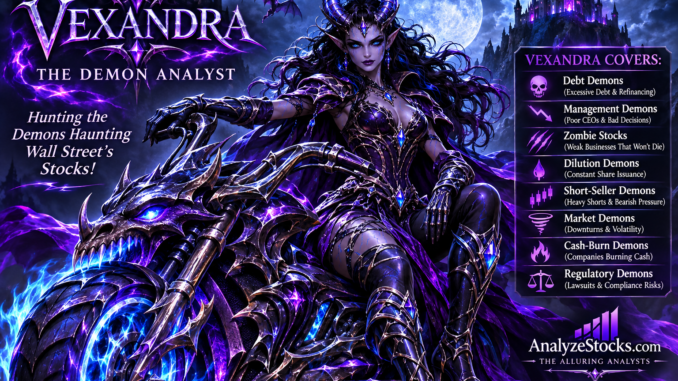
Welcome to The Risk Demon Report, where Vexandra—better known as Vexxy—hunts the financial demons hiding behind attractive stock prices.
Today, she’s exposing five warning signs that investors should investigate before buying the dip.
Demon #1: The Cash Burner
Warning sign: A company is spending money much faster than it can generate it.
Young technology companies frequently operate at a loss while developing products, building infrastructure, or expanding into new markets.
That isn’t automatically a problem.
The danger appears when a company’s cash consumption threatens its ability to survive long enough to achieve its business objectives.
Vexxy’s investigation begins with three questions:
- How much cash and short-term liquidity does the company have?
- How much cash is it consuming through operations?
- How long can it continue at its current spending rate?
Consider a hypothetical company holding $120 million in cash while consuming $30 million per quarter.
At that rate, it has approximately four quarters of cash runway before considering financing, changes in spending, or other cash flows.
And that’s assuming its spending doesn’t accelerate.
Vexxy’s verdict: A revolutionary technology means little if the company runs out of money before commercial success arrives.
Demon #2: The Dilution Devil
Warning sign: Existing shareholders keep receiving smaller pieces of the company.
Some businesses finance their growth by issuing additional shares.
That can be reasonable when the proceeds create sufficient long-term value. But repeated share issuance can also dilute existing investors.
Imagine a company with 100 million shares outstanding.
It issues another 50 million shares to raise capital.
An investor who previously owned 1% of the company now owns approximately 0.67%, assuming that investor buys no additional shares.
The business may have received much-needed cash, but the ownership percentage has declined.
Vexxy looks for rising share counts, frequent equity offerings, convertible securities, warrants, and substantial stock-based compensation.
She also examines whether management is creating enough business value to justify the dilution.
Vexxy’s verdict: A rising business valuation doesn’t necessarily translate into rising value per share.
Demon #3: The Balance Sheet Beast
Warning sign: Debt and financial obligations are overwhelming the company’s resources.
Debt isn’t inherently evil.
Profitable businesses routinely borrow money to finance expansion, acquisitions, and equipment.
But excessive debt becomes dangerous when revenue weakens, interest expenses rise, or lenders become less willing to refinance existing obligations.
Vexxy examines:
- Cash relative to near-term debt maturities
- Interest expense and the company’s ability to service it
- Current assets compared with current liabilities
- Debt covenants, refinancing needs, and other obligations
A company with substantial long-term potential can still experience serious financial distress if it cannot meet its immediate obligations.
And during market downturns, financing may become more expensive precisely when struggling companies need it most.
Vexxy’s verdict: A strong product cannot compensate indefinitely for an unsustainable capital structure.
Demon #4: The Demand Destroyer
Warning sign: Customers are disappearing, orders are weakening, or revenue growth is deteriorating.
This demon can be especially deceptive.
A company’s stock might look inexpensive based on its historical revenue or earnings, even while the business is losing momentum.
Vexxy looks beyond a single disappointing quarter.
She investigates whether falling revenue reflects temporary conditions or a deeper problem.
Are customers postponing purchases?
Is competition taking market share?
Are order backlogs shrinking?
Are existing customers spending less?
Is the company’s technology becoming obsolete?
Not every revenue decline signals permanent trouble. Cyclical industries can experience severe but temporary contractions.
The challenge is determining whether demand is likely to recover—and whether the company can remain financially healthy while waiting.
Vexxy’s verdict: Before betting on a recovery, find evidence that customers still want what the company sells.
Demon #5: The Valuation Vampire
Warning sign: A stock has fallen dramatically but remains expensive relative to its fundamentals.
This may be the most seductive demon of all.
A stock that falls from $100 to $40 has declined 60%.
But that doesn’t prove $40 represents fair value.
Perhaps the original $100 price assumed extraordinary growth, high profit margins, and flawless execution.
If those assumptions were unrealistic, the stock could remain overvalued even after its dramatic decline.
Vexxy considers valuation measures appropriate to the business, including price-to-earnings, price-to-sales, enterprise value relative to operating performance, free cash flow, and reasonable estimates of future profitability.
She also examines the assumptions embedded in those valuations.
A business without current profits may require scenario analysis rather than a conventional earnings multiple.
Vexxy’s verdict: A 60% discount from an unreasonable price is not necessarily a bargain.
The Five-Demon Checklist
Before purchasing a beaten-down stock, investigate the following:
| Risk demon | Question to answer |
|---|---|
| Cash Burner | Can the company fund its operations? |
| Dilution Devil | Will future financing significantly dilute shareholders? |
| Balance Sheet Beast | Can the company meet its financial obligations? |
| Demand Destroyer | Is customer demand stable, recovering, or deteriorating? |
| Valuation Vampire | Does the current price offer a reasonable margin of safety? |
One warning sign doesn’t automatically disqualify an investment.
A cash-burning company with exceptional growth prospects, ample liquidity, and disciplined management may offer a compelling opportunity.
Likewise, a financially strong company may still be a poor investment if its stock price assumes unrealistic future performance.
The objective is not to eliminate every risk.
It’s to understand the risks before committing capital.
Vexxy’s Final Warning: Don’t Confuse a Falling Price With a Buying Opportunity
Some of tomorrow’s greatest winners will emerge from periods of market fear.
Others will never recover.
The difference often comes down to business fundamentals, financial durability, management execution, and the price investors pay.
For investors following an Add Lower strategy, a declining share price may create opportunities to accumulate positions gradually.
But averaging down without reassessing the underlying business can magnify losses.
That’s why every potential purchase deserves a fresh examination.
Has the investment thesis improved?
Has the business remained fundamentally sound?
Has the valuation become more attractive?
Or has another financial demon emerged?
Vexxy’s final verdict:
“A falling stock price doesn’t frighten me. A deteriorating business disguised as a bargain does. Find the demons before they find your portfolio.”
No Price, No Buy. Know the Risk Before You Buy the Dip.
Disclaimer: This article is for informational and educational purposes only and does not constitute personalized investment advice. All numerical examples are hypothetical. Investing involves risk, including the possible loss of principal. Investors should conduct their own research and consider their financial circumstances before making investment decisions.