
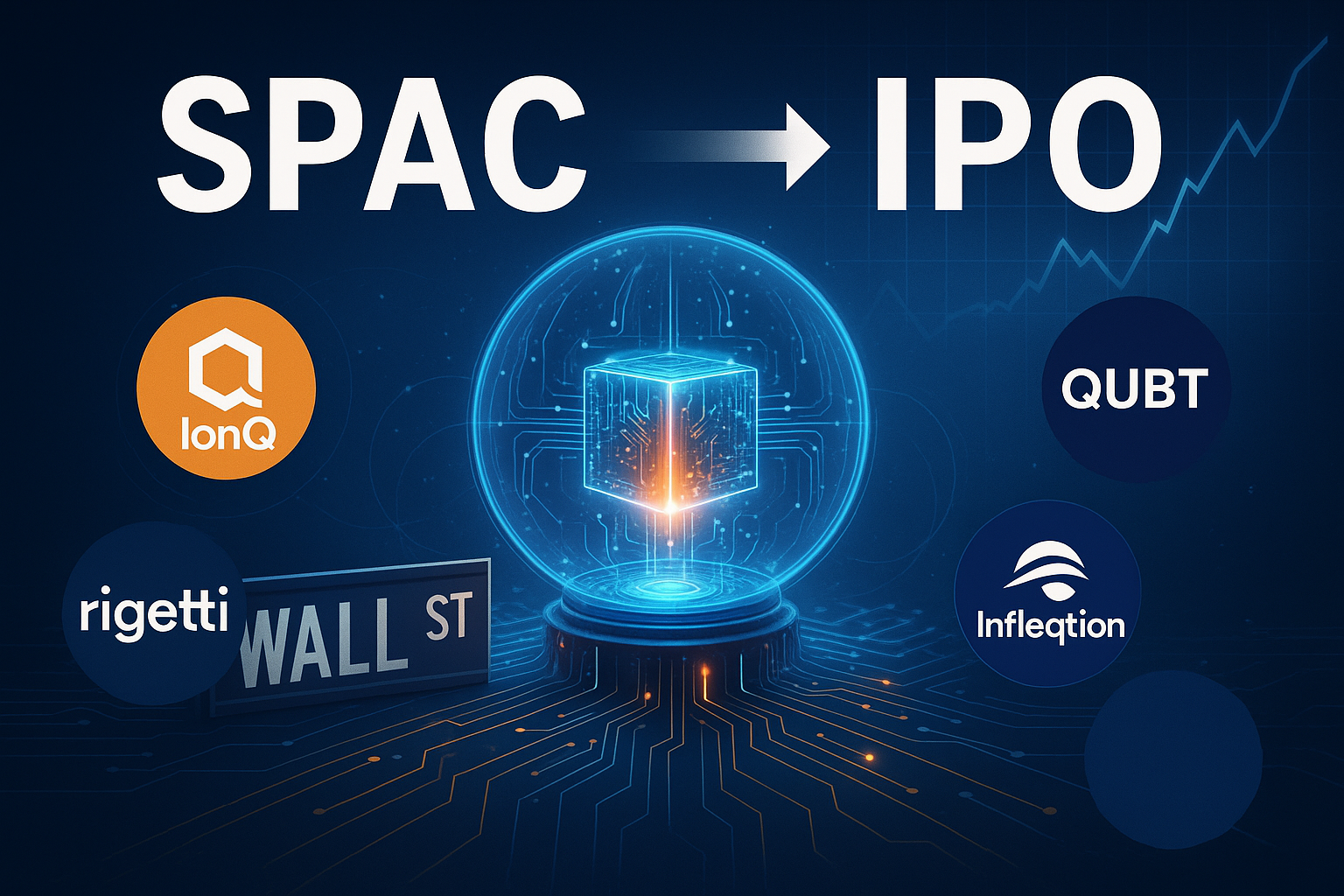

Quantum computing startups have been riding a wave of hype, innovation, and investment—but their path to the public markets hasn’t always been conventional. Instead of traditional IPOs, several pure play quantum firms took the SPAC (Special Purpose Acquisition Company) route. For investors, this “SPAC effect” has created both opportunities and pitfalls. Let’s look at how quantum startups went public, what’s happened since, and what might come next.
What Is the SPAC Effect?
A SPAC, or “blank check company,” is essentially a shell firm created to raise capital through an IPO and then merge with a private company. For startups in cutting-edge but risky industries like quantum computing, SPACs provided:
- Faster access to capital than traditional IPOs.
- High valuations based on future projections rather than current revenue.
- Investor excitement during the 2020–2021 SPAC boom.
But with this fast track came volatility: inflated valuations, investor skepticism, and the challenge of proving real-world progress in a still-emerging field.
Quantum Startups That Went Public via SPAC
IonQ (NYSE: IONQ)
- The first pure play quantum company to hit the public markets via SPAC in 2021.
- Initially valued at around $2 billion.
- Partnerships with Microsoft Azure, AWS, and Google Cloud.
- Stock has experienced sharp swings, reflecting both quantum hype and questions about commercialization.
Rigetti Computing (NASDAQ: RGTI)
- Merged with Supernova Partners in early 2022.
- Focused on superconducting qubit technology.
- Valuation dropped significantly post-merger as investors demanded real revenue.
- Still seen as a serious contender in quantum hardware.
Quantum Computing Inc. (NASDAQ: QUBT)
- Earlier to the market but still part of the SPAC-era effect.
- Positioned as a software-first quantum company.
- Often criticized for volatility but maintains a presence as a speculative play.
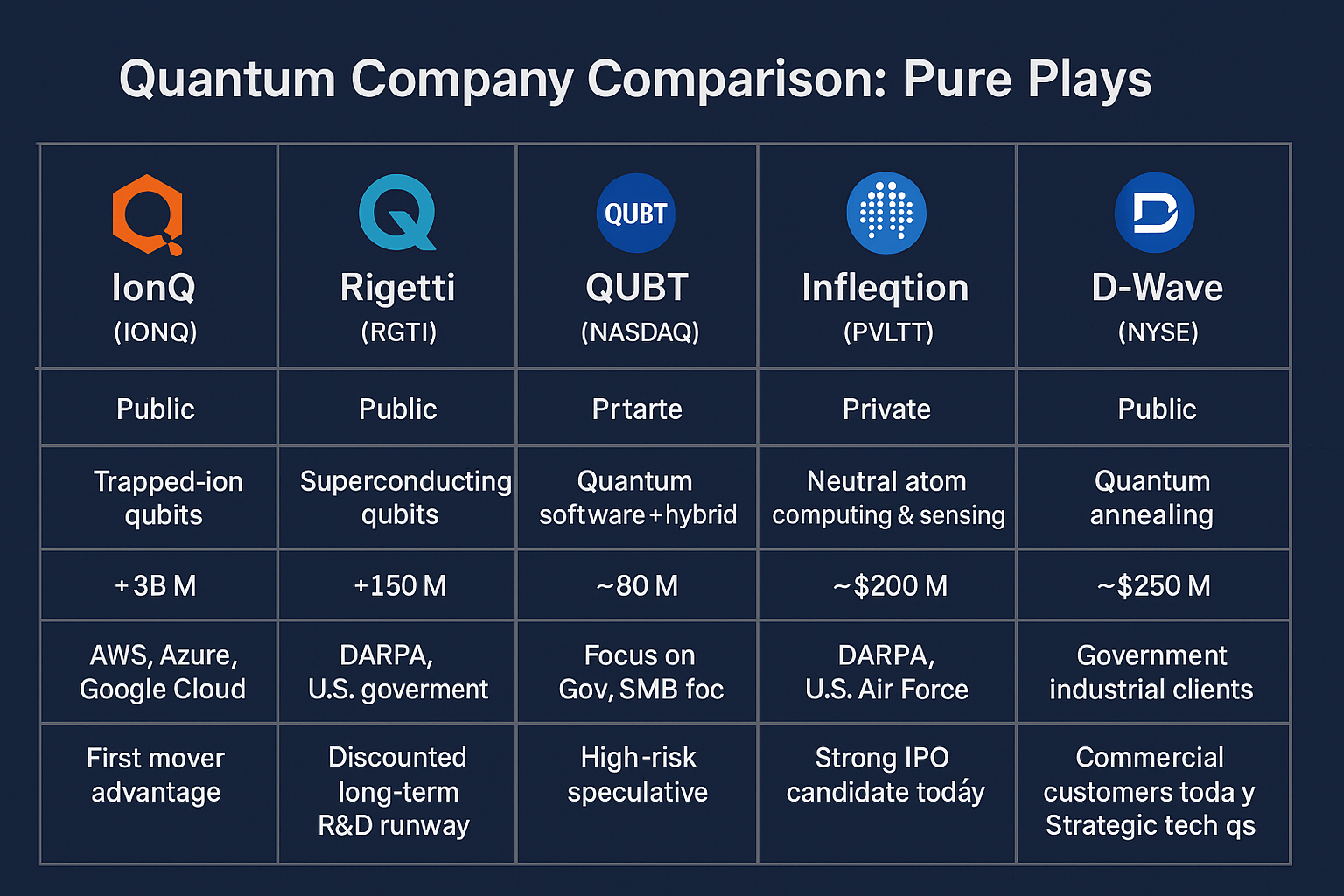
Quantum Company Comparison: Public vs. Private Pure Plays
| Company | Status | Core Technology | Market Cap / Funding | Key Partnerships & Customers | IPO / Growth Outlook |
|---|---|---|---|---|---|
| IonQ (IONQ) | Public (NYSE) | Trapped-ion qubits | ~$3B market cap (2025) | AWS Braket, Microsoft Azure, Google Cloud | First mover advantage, strong partnerships; high volatility |
| Rigetti (RGTI) | Public (NASDAQ) | Superconducting qubits | ~$150M market cap (2025) | U.S. government contracts, DARPA, cloud providers | Valuation dropped post-SPAC; long R&D runway |
| QUBT (Quantum Computing Inc.) | Public (NASDAQ) | Quantum software + hybrid solutions | ~$80M market cap (2025) | Focus on small/mid enterprises, government agencies | High-risk, speculative play; volatility remains |
| Infleqtion (formerly ColdQuanta) | Private | Neutral atom quantum computing & quantum sensors | $200M+ raised privately | DARPA, U.S. Air Force, collaborations in quantum networking | Strong IPO candidate in coming years; dual focus on computing + sensing |
What Happened After the SPAC Wave
- Volatility and Corrections: Many quantum SPACs saw their valuations tumble as initial hype gave way to the long commercialization timelines of quantum tech.
- Increased Scrutiny: Investors began demanding more transparency, revenue growth, and tangible milestones.
- Strategic Partnerships: To gain credibility, quantum firms leaned on partnerships with big tech (Google, Microsoft, Amazon) and government contracts.
What’s Next for Quantum and the Public Markets?
- Potential New Entrants
- Private giants like PsiQuantum, Xanadu, and Atom Computing are still waiting in the wings.
- Infleqtion (formerly ColdQuanta) is another standout. Based in Boulder, Colorado, Infleqtion is pioneering neutral atom-based quantum systems and quantum sensors. With DARPA projects, U.S. Air Force work, and collaborations in quantum networking, it’s a strong candidate for a future IPO.
- M&A Activity
- Larger tech firms could acquire smaller quantum startups to bolster their capabilities.
- Infleqtion’s dual focus on computing + sensing makes it a particularly attractive target.
- ETFs and Diversified Plays
- Quantum-focused ETFs may rise in popularity, offering safer exposure than single speculative stocks.
- Long-Term Horizon
- Quantum remains a decade-long play. Investors must weigh short-term volatility against massive long-term potential.
Conclusion
The SPAC effect allowed quantum startups like IonQ and Rigetti to access capital and investor attention sooner than expected, but it also exposed the risks of overvaluation in an emerging industry. While public players like IonQ, Rigetti, and QUBT continue to evolve, the real intrigue may lie with private leaders like Infleqtion preparing for their turn on the public stage.
For forward-looking investors, the lesson is clear: quantum computing is a marathon, not a sprint. The SPAC wave was just the opening lap.

Be the first to comment