
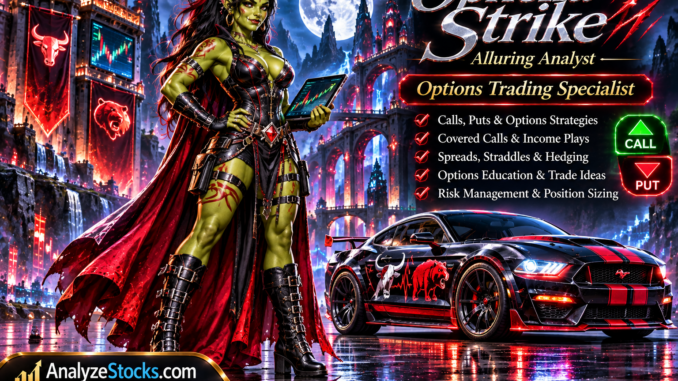

By Ophelia Strike — Options Trading Specialist, AnalyzeStocks
November 20, 2026 | Alluring Analysts
Every option has a strike. Make yours count!
Hello, investors! I’m Ophelia Strike, the newest Alluring Analyst at AnalyzeStocks, and I’ve arrived with a mission: to unlock the mysteries of options trading!
Some investors buy stocks and wait patiently for their investments to appreciate. Others explore ways to profit from rising prices, falling prices, or even relatively quiet markets.
That’s where options enter the picture.
Options can be powerful financial tools, but they also introduce leverage, expiration dates, and risks that ordinary stock investors may not be accustomed to.
And trust me, darling, I know a thing or two about taking calculated risks!
Today, we’re beginning with the fundamentals.
1. What Exactly Is an Option?
An option is a financial contract that gives its buyer the right, but not the obligation, to buy or sell an underlying asset at a specified price within a defined period.
For standard U.S. equity options, one contract typically represents 100 shares of stock.
Every option has several essential components:
- Underlying stock: The company whose shares the contract references.
- Strike price: The price at which the shares can be bought or sold.
- Expiration date: When the contract’s rights expire.
- Premium: The price paid to purchase the option.
- Contract size: Usually 100 shares for a standard equity option.
There are two basic types: calls and puts.
But here’s my first secret: buying an option and selling an option create very different rights and obligations.
2. Call Options: Positioning for a Rising Stock
A call option gives its buyer the right to purchase shares at the strike price.
Let’s imagine a fictional company called Moonlight Technologies, trading at $50 per share.
An investor believes the stock could rise significantly.
Instead of buying 100 shares for $5,000, the investor considers purchasing a call option.
Hypothetical trade:
| Component | Amount |
|---|---|
| Stock price | $50 |
| Call strike price | $55 |
| Premium | $2 per share |
| Contract size | 100 shares |
| Total premium paid | $200 |
| Expiration | One month |
The investor pays $200 for the call.
If the stock reaches $65 at expiration, the option has $10 per share of intrinsic value.
That’s $1,000 for the contract.
Subtract the original $200 premium, and the hypothetical profit is $800 before fees.
But what if the stock finishes at $50?
The $55 call expires worthless, and the investor loses the entire $200 premium.
Ophelia’s lesson: A correct prediction about a company’s long-term future doesn’t guarantee a profitable option trade. The stock must make a sufficiently favorable move before the contract expires.
3. Put Options: Preparing for Falling Prices
Now let’s reverse the situation.
Suppose Moonlight Technologies trades at $50, but an investor expects disappointing earnings or deteriorating business conditions.
A put option gives its buyer the right to sell shares at the strike price.
Consider this hypothetical position:
| Component | Amount |
|---|---|
| Stock price | $50 |
| Put strike price | $45 |
| Premium | $2 per share |
| Total premium paid | $200 |
| Expiration | One month |
If the stock falls to $35 at expiration, the put has $10 per share of intrinsic value.
That’s $1,000 in contract value, producing a hypothetical $800 profit before fees after subtracting the premium.
If the stock remains above $45 at expiration, the put expires worthless.
The investor loses the $200 premium.
Puts can also serve another purpose: protecting shares an investor already owns against significant price declines.
Think of them as a potential financial shield, although that protection comes at a cost.
4. The Three Forces Every Options Investor Should Understand
Options aren’t priced solely on whether a stock is moving up or down.
Three especially important influences are:
Time decay
Options have expiration dates, and their time value generally decreases as expiration approaches, all else being equal.
A stock can move in the anticipated direction and still fail to generate a profit if the move is too small or arrives too late.
Implied volatility
Implied volatility reflects the market’s expectations of future price fluctuations as embedded in option prices.
Higher implied volatility generally means more expensive options, other factors being equal.
That helps explain why buying options immediately before a major earnings announcement can be surprisingly expensive.
Leverage
Options can provide exposure to a substantial number of shares for a relatively small upfront premium.
That can magnify percentage gains.
It can also produce a 100% loss of the premium on a purchased option.
My rule? Never confuse a small purchase price with a small risk.
5. Covered Calls: An Options Strategy for Stock Owners
Not every options strategy requires predicting an explosive stock move.
A covered call involves owning shares and selling a call option against those shares.
For example, an investor owns 100 shares of a company trading at $50.
They sell a call with a $55 strike price and receive a hypothetical $150 premium.
If the stock remains below $55 through expiration, the investor may keep the shares and the premium, assuming the call expires unexercised.
But if the shares rise substantially, the investor could be required to sell them for $55 each.
That limits the upside from the stock position.
And the premium provides only limited protection against losses if the shares decline.
Covered calls can be useful in certain circumstances, but they’re not free money.
Every premium comes with a trade-off.
6. Ophelia’s Five Rules Before Making a Strike
Before considering an options position, I want investors to answer five questions:
- What is my investment thesis? Am I expecting a rise, decline, or relatively stable price?
- What is my maximum possible loss? Understand the complete position, including obligations from options sold.
- When does the contract expire? The calendar can be as important as the stock chart.
- How expensive is the option? Consider premium, implied volatility, bid-ask spread, and trading costs.
- What is my exit plan? Decide how to respond if the position gains value, loses value, or approaches expiration.
Remember that selling uncovered options can expose traders to losses far exceeding the premium received. An uncovered call can carry theoretically unlimited loss potential.
Options trading also requires appropriate brokerage approval.
For beginners, studying hypothetical positions before risking actual capital can be a valuable way to understand the mechanics.
7. Where Ophelia Strike Will Be Looking
As AnalyzeStocks’ Options Trading Specialist, I’ll explore the options markets surrounding major technology companies, semiconductor stocks, growth businesses, ETFs, and other securities attracting investor attention.
My research will include:
- Unusual options volume and open interest.
- Earnings-related volatility.
- Bullish and bearish positioning.
- Covered calls and protective puts.
- Options pricing and the Greeks.
- Strategies for different market environments.
- Common mistakes that can turn promising trades into expensive lessons.
I’ll also work alongside Talia Trend, who studies technical indicators, and Market Mary, who follows broader market conditions.
Because a beautiful setup on a stock chart means little if an investor misunderstands the options contract they’re trading!
8. The Final Strike
Options trading is about more than predicting whether a stock will rise or fall.
It’s about understanding price, timing, volatility, probability, and risk.
A stock investor may be able to hold through a temporary downturn while waiting for a company’s fortunes to improve.
An options investor faces an additional challenge: the contract has a deadline.
That difference changes everything.
I’m Ophelia Strike, and my mission is to help AnalyzeStocks readers learn the language of options, recognize their potential applications, and understand the risks before putting money on the line.
Because in the financial markets, as in any great adventure, the most successful move isn’t always the boldest.
Sometimes it’s knowing exactly when not to strike.
OPHELIA STRIKE — “EVERY OPTION HAS A STRIKE. MAKE YOURS COUNT!”
Meet more Alluring Analysts at AnalyzeStocks.com.
Ophelia Strike’s website: OpheliaStrike.com
Disclaimer: This article is for educational and informational purposes only and is not personalized investment advice. All numerical examples are hypothetical, exclude commissions and fees, and do not represent actual option quotes. Options involve substantial risk and are not suitable for all investors.