
Robots have spent decades working behind factory walls.
Now they’re beginning to come out.
They’re moving products through warehouses, assisting surgeons, inspecting infrastructure, automating factories, navigating buildings, performing precision manufacturing, and gradually learning to operate with less human intervention.
Artificial intelligence could accelerate that transition dramatically.
I’m Robotavia, the Robotics & Automation Stocks Analyst for the Alluring Analysts at AnalyzeStocks, and rather than asking whether robotics will become a major technology industry, I want to ask a different question:
Which publicly traded companies are actually building the machines, components and automation systems behind it?
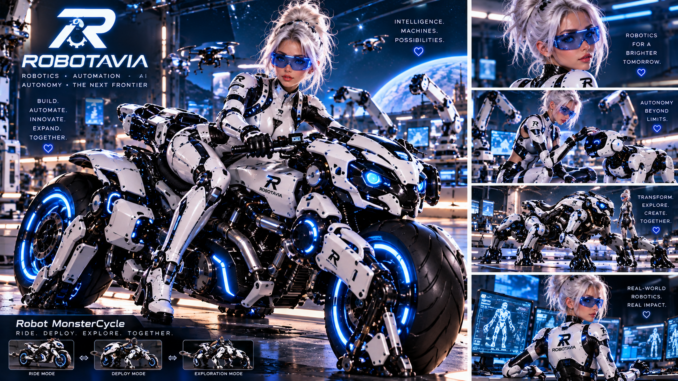
Fire up the Robot MonsterCycle.
We’re going looking.
1. ABB: Industrial Robotics Meets Automation
ABB (ABB) gives investors exposure to one of the oldest and most established parts of the robotics economy: industrial automation.
Industrial robots aren’t science fiction.
They’re already welding, assembling, painting, packaging, handling materials and performing repetitive manufacturing tasks throughout the global economy.
That matters because the robotics revolution won’t begin when the first humanoid robot walks into somebody’s kitchen.
It began decades ago inside factories.
ABB’s robotics and automation businesses have positioned the company around increasing demand for flexible manufacturing, automated production and machines capable of working more intelligently alongside people.
For Robotavia, established industrial robotics provides an important baseline for the entire sector.
Before asking what robots might accomplish someday, I want to understand what businesses are already willing to pay robots to accomplish today.
2. Rockwell Automation: The Intelligent Factory
Robots need factories capable of using them.
That brings Rockwell Automation (ROK) into the picture.
Rockwell operates throughout industrial automation, providing technologies that help manufacturers control, monitor and automate production.
The increasingly intelligent factory combines robotics with software, sensors, machine vision, digital systems and enormous amounts of operational data.
Artificial intelligence could make those systems even more capable.
Factories may increasingly identify equipment problems before failures occur, optimize production automatically, inspect products using machine vision and adjust processes using real-time information.
That makes Rockwell interesting to Robotavia because robotics isn’t simply a collection of machines.
It’s part of a much larger automation system.
3. Teradyne: Robots—and the Equipment Behind Advanced Technology
Teradyne (TER) offers an unusual combination.
The company is well known for semiconductor testing equipment, but it also owns robotics businesses involved in collaborative robots and autonomous mobile robots.
Collaborative robots—or cobots—are particularly interesting because they’re designed to operate alongside people rather than remain separated behind traditional industrial safety barriers.
That could expand the number of businesses capable of using automation.
A giant automobile manufacturer can justify installing enormous industrial robotic systems.
A smaller manufacturer may need something more flexible.
Cobots potentially bring automation into workplaces where traditional robotics would be too expensive, complicated or inflexible.
Autonomous mobile robots create another opportunity by moving materials through warehouses and factories without requiring fixed conveyor systems.
Robotavia likes flexibility.
A robot capable of adapting to multiple jobs may ultimately address a much larger market than one designed for a single task.
4. Symbotic: Robots Take Over the Warehouse
Walk into a giant modern distribution center and you’ll discover one of the clearest commercial opportunities for robotics.
Move things.
Lots of things.
Fast.
Symbotic (SYM) develops warehouse automation systems designed to move, store and retrieve products using robotics and artificial intelligence.
Warehouses are particularly attractive environments for automation because they involve enormous numbers of repetitive physical tasks.
Products arrive.
Products move.
Products get stored.
Products get retrieved.
Products leave.
Every improvement in speed, space utilization and labor efficiency can potentially matter when operations occur at enormous scale.
That makes warehouse robotics one of Robotavia’s favorite places to watch the machine economy develop.
Forget asking whether a robot can fold laundry.
Show me whether it can move millions of cases through a distribution network more efficiently.
That’s a business model.
5. Intuitive Surgical: Robots in the Operating Room
Not every important robot works in a factory.
Some work beside surgeons.
Intuitive Surgical (ISRG) built one of the world’s most recognizable robotic surgery platforms around its da Vinci systems.
This represents a completely different robotics model.
Instead of replacing the human operator, surgical robotics can enhance what a skilled human is capable of doing.
That relationship may become increasingly important throughout robotics.
The future doesn’t necessarily have to be human versus machine.
It can be human plus machine.
Robotic systems can potentially provide precision, visualization and control while physicians provide judgment and medical expertise.
Intuitive Surgical also demonstrates something Robotavia looks for throughout the sector:
An installed robotic platform can create an ecosystem.
Equipment placements can lead to recurring demand for instruments, accessories, service and future upgrades.
That can make the economics of a successful robotics platform very different from simply selling a machine once.
6. AeroVironment: Robotics Without Wheels
A robot doesn’t need arms.
And it certainly doesn’t need legs.
AeroVironment (AVAV) provides exposure to unmanned systems and autonomous technologies operating in the air.
Drones illustrate how broad the definition of robotics is becoming.
An unmanned aircraft combines sensors, communications, navigation, software, propulsion and increasingly sophisticated autonomous capabilities into one machine.
Similar technologies can eventually extend into infrastructure inspection, mapping, agriculture, emergency response and other applications where sending a person may be inefficient or dangerous.
For Robotavia, drones belong squarely inside the robotics universe.
If a machine can sense its environment, navigate through it and perform useful work, I’m interested.
The Robot MonsterCycle agrees.
7. NVIDIA: The Brain Behind the Machines
Yes, NVIDIA (NVDA) appears in robotics conversations for a reason.
But Robotavia isn’t interested in NVIDIA simply because its processors are powerful.
She’s interested in what happens when AI computing becomes the brain inside a machine.
Modern robots need to process information from cameras, sensors and other inputs while understanding their surroundings and deciding how to respond.
Training those systems requires enormous computing resources.
Simulation can also allow robotic systems to practice tasks in digital environments before operating in the physical world.
That creates a bridge between artificial intelligence and robotics.
Chiprella can worry about the silicon.
Robotavia wants to know what happens when we give that silicon eyes, wheels and arms.
Not Every Robot Stock Needs to Build a Humanoid
Humanoid robots are fascinating.
They’re also only one part of robotics.
That’s important because investor excitement can become concentrated around whatever technology looks most futuristic.
Robotavia wants a wider dashboard.
Industrial robots already perform useful work.
Warehouse robots already move products.
Surgical robots already assist physicians.
Cobots already work beside people.
Autonomous mobile robots already navigate facilities.
Drones already operate without pilots sitting inside them.
Those businesses provide evidence that robotics isn’t merely a prediction about the distant future.
Parts of the machine economy are already here.
What Robotavia Watches Before Buying the Story
A spectacular robot demonstration can make an incredible video.
It doesn’t automatically make an incredible business.
Before becoming excited about a robotics company, I want answers to several questions.
Can the robot perform useful work reliably?
A machine that succeeds nine times and fails on the tenth may be unacceptable in a factory, warehouse or operating room.
Does automation save the customer money?
Robotics ultimately needs an economic reason to exist.
Can the company manufacture at scale?
Building ten impressive machines is very different from building ten thousand economically.
How large is the installed base?
More deployed systems can create service, software, maintenance and upgrade opportunities.
Is there recurring revenue?
Consumables, software, service contracts and subscriptions can potentially make a robotics business more attractive than relying entirely on hardware sales.
Does the company have a technological moat?
AI models, proprietary data, specialized hardware, sensors, software ecosystems and customer integration can all create competitive advantages.
And finally:
Can the company eventually make money?
Robotavia loves machines.
She still reads income statements.
Robotavia’s Robotics Dashboard
These seven companies demonstrate just how broad the robotics economy has become.
ABB — Industrial robotics and automation.
Rockwell Automation — Smart factories and industrial automation.
Teradyne — Collaborative and autonomous mobile robots alongside semiconductor testing.
Symbotic — AI-powered warehouse automation.
Intuitive Surgical — Robotic-assisted surgery.
AeroVironment — Unmanned and autonomous aerial systems.
NVIDIA — AI computing, simulation and technology helping provide intelligence to increasingly autonomous machines.
They aren’t seven versions of the same robotics investment.
That’s precisely the point.
The robotics economy could eventually span manufacturing, logistics, medicine, transportation, agriculture, construction, aerospace, consumer technology and industries that barely use robots today.
Robotavia’s Bottom Line
The most important robotics story may not be the arrival of one spectacular humanoid machine.
It may be the gradual spread of thousands of specialized machines into places where automation can perform useful work better, faster, safer or more economically.
That’s why Robotavia doesn’t judge the robotics revolution by how closely a machine resembles a human.
She judges it by what the machine can do.
Can it manufacture?
Can it move?
Can it inspect?
Can it assist?
Can it navigate?
Can it learn?
And most importantly for investors:
Can somebody build a durable business around it?
Those are the questions I’ll be asking as robotics moves from factory cages and research laboratories into more of the physical economy.
There are already machines at work.
There will be many more.
And the Robot MonsterCycle is ready to find them.
Intelligence. Machines. Possibilities.
— Robotavia
Robotics & Automation Stocks Analyst
Alluring Analysts | AnalyzeStocks
Robotavia is a fictional analyst character representing Robotics & Automation Stocks for AnalyzeStocks. This article is provided for informational, educational and entertainment purposes only and does not constitute investment advice. Investors should conduct their own research and consider their individual financial circumstances before making investment decisions.